
TRAILER AND FLEET TIRE MONITORING
Trailer TPMS System for Trucks and Commercial Fleets
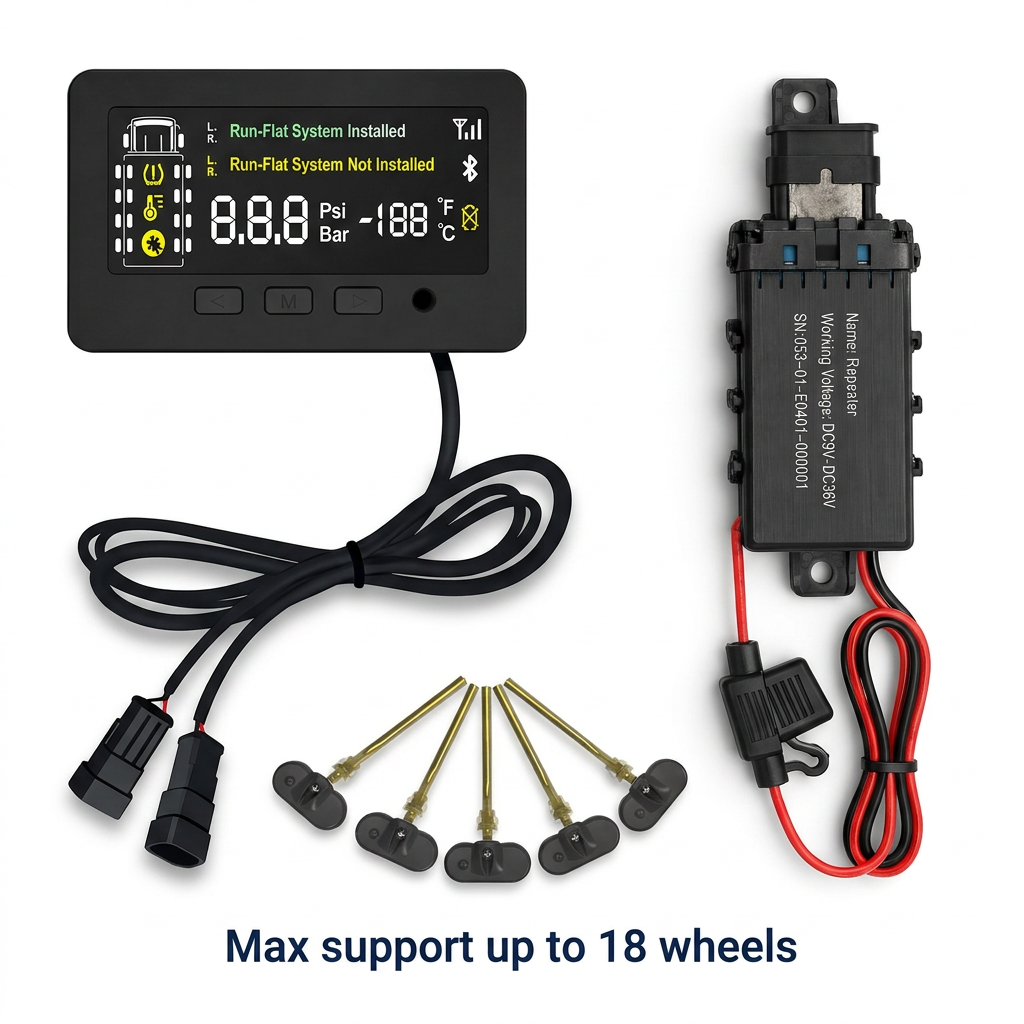
Monitor tractor and trailer tires across long vehicle combinations. The smart repeater enables automatic trailer exchange and trailer swap, allowing the truck TPMS display to match the connected trailer sensor group without manual reconnection.
Why Trailers Need a Dedicated TPMS System
Long tractor-trailer combinations create greater signal distance, more wheel positions and frequent trailer changes. A dedicated trailer TPMS system keeps tractor and trailer tire data organized while supporting long-range reception and interchangeable trailer operations.
Long Signal Distance
Repeaters maintain stable 433.92 MHz communication across long tractor-trailer combinations.
Frequent Trailer Changes
Smart repeaters support automatic matching when fleets exchange or swap equipped trailers.
High Wheel Counts
Choose an 18-wheel CAN J1939 solution or a 46-wheel RS232/RS485 display configuration.
Data Separation
Keep the connected trailer sensor group associated with the tractor-side display.
Complete Trailer TPMS Solution
Configure sensors, repeaters, receiver or display and pairing tools according to the trailer type, wheel count and fleet operating model.
Trailer TPMS Sensors
Valve internal, band internal and external sensors measure pressure and temperature at each trailer wheel.
Standard Repeater
Extends 433.92 MHz signal coverage for long vehicles and demanding installation layouts.
Smart Repeater
Associates the trailer sensor group and enables automatic trailer exchange and trailer swap matching.
TDS200 CAN J1939 Receiver
Supports up to 18 wheels for compatible vehicle or telematics integration. Receiver and display OTA upgrades are supported through the applicable upgrade method.
TDS300 RS232/RS485 Display
Supports up to 46 wheels and can forward TPMS data to compatible GPS or fleet hardware.
Activation and Pairing Tool
Wake sensors and assign sensor IDs during installation, maintenance or fleet configuration.
Smart Repeater for Automatic Trailer Exchange and Trailer Swap
Each interchangeable trailer is equipped with its own TPMS sensors and smart repeater. When the tractor connects to Trailer A, Trailer B or Trailer C, the truck TPMS display automatically matches the connected trailer sensor group.
Trailer A
The display receives and shows the TPMS sensors associated with Trailer A through its smart repeater.
Trailer B
After the tractor changes trailers, the display automatically matches the Trailer B sensor group.
Trailer C
The same display can automatically switch to Trailer C without manually reconnecting the display and repeater.
This automatic matching function supports logistics fleets that frequently exchange or swap interchangeable trailers and reduces repeated manual pairing work.
Trailer TPMS System Topology
The signal path keeps the trailer sensor group connected to the driver display and, when required, a compatible fleet platform.
Wheel and Repeater Configuration
Use wheel count and vehicle length as the starting point for repeater planning. Final quantity depends on the actual installation and signal conditions.
| Vehicle or Wheel Configuration | Typical Recommendation |
|---|---|
| 4–6 wheels | Repeater optional depending on vehicle length and installation |
| 6–14 wheels | Normally 1 repeater |
| More than 14 wheels | Normally 2 repeaters |
| Long multi-axle combination | Confirm through project configuration and installation testing |
| Interchangeable trailer fleet | Applicable smart repeater on each trailer requiring automatic exchange or swap matching |
Trailer TPMS Applications
Select the system configuration according to trailer structure, wheel count, operating environment and trailer exchange workflow.
Semi Trailers
Monitor multi-axle semi-trailer tire pressure, temperature and alarms.
Logistics Trailers
Support fleet operations where tractors frequently exchange equipped trailers.
Tank Trailers
Configure sensor type and repeaters according to the tank trailer layout.
Refrigerated Trailers
Maintain tire monitoring across long refrigerated trailer combinations.
Car Carriers
Plan signal coverage for long, multi-level vehicle transport trailers.
Multi-Axle Trailers
Assign sensors to multiple wheel positions and select the correct receiver limit.
Interchangeable Trailers
Use smart repeaters for automatic trailer exchange and trailer swap operations.
Pairing and Wheel Position Management
Assign each sensor ID to the correct trailer wheel position during installation and service.
Activation Tool Pairing
Wake sensors and pair sensor IDs using the optional TPMS activation tool.
QR Scan or Sensor ID Input
Scan a supported QR code or enter the sensor ID manually where the selected configuration supports it.
Automatic Trailer Group Matching
After installation, the smart repeater allows the truck display to automatically match the connected trailer sensor group. This is separate from wheel-position auto-localisation.
Trailer TPMS Sensor Options
Choose the sensor installation method according to the rim, tire and fleet maintenance requirements.
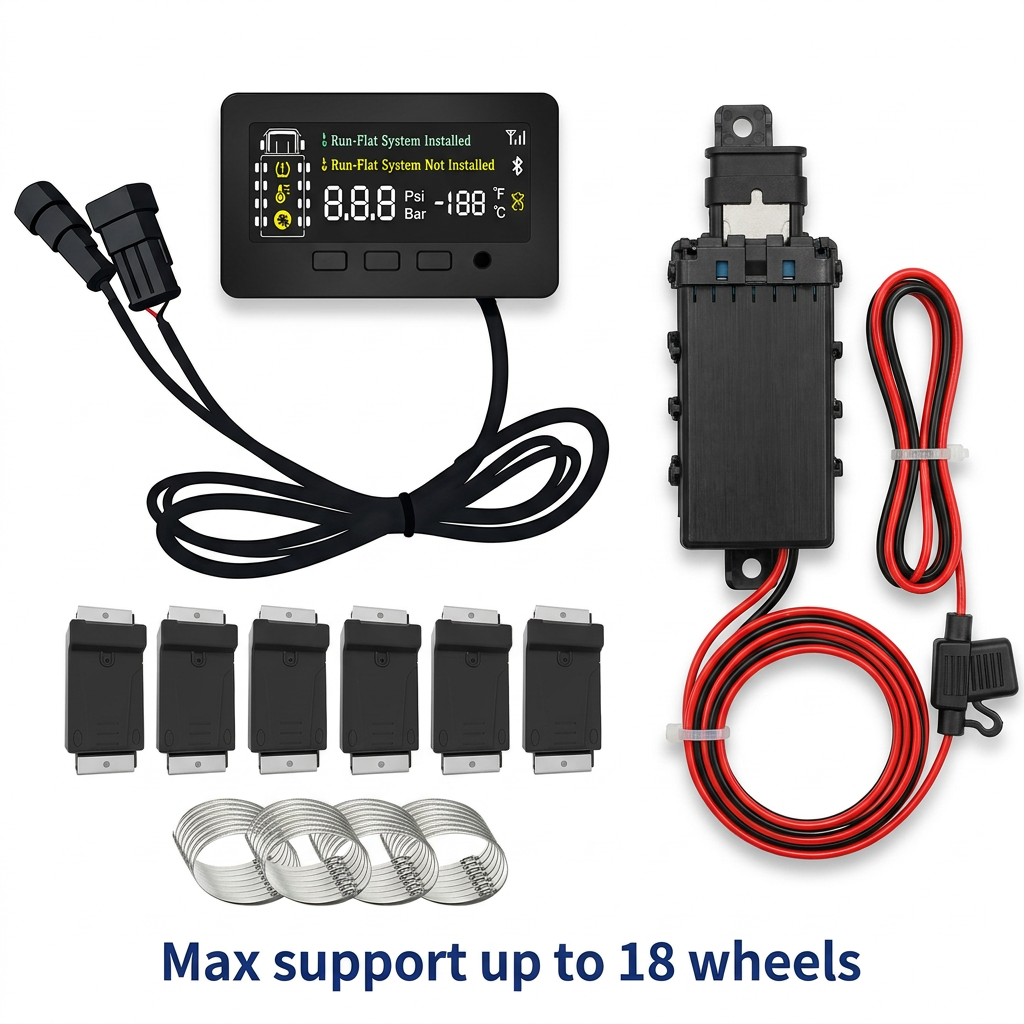
Protected installation inside many heavy-duty trailer wheels.
Replaces a compatible tubeless tire valve and measures pressure and temperature inside the tire.
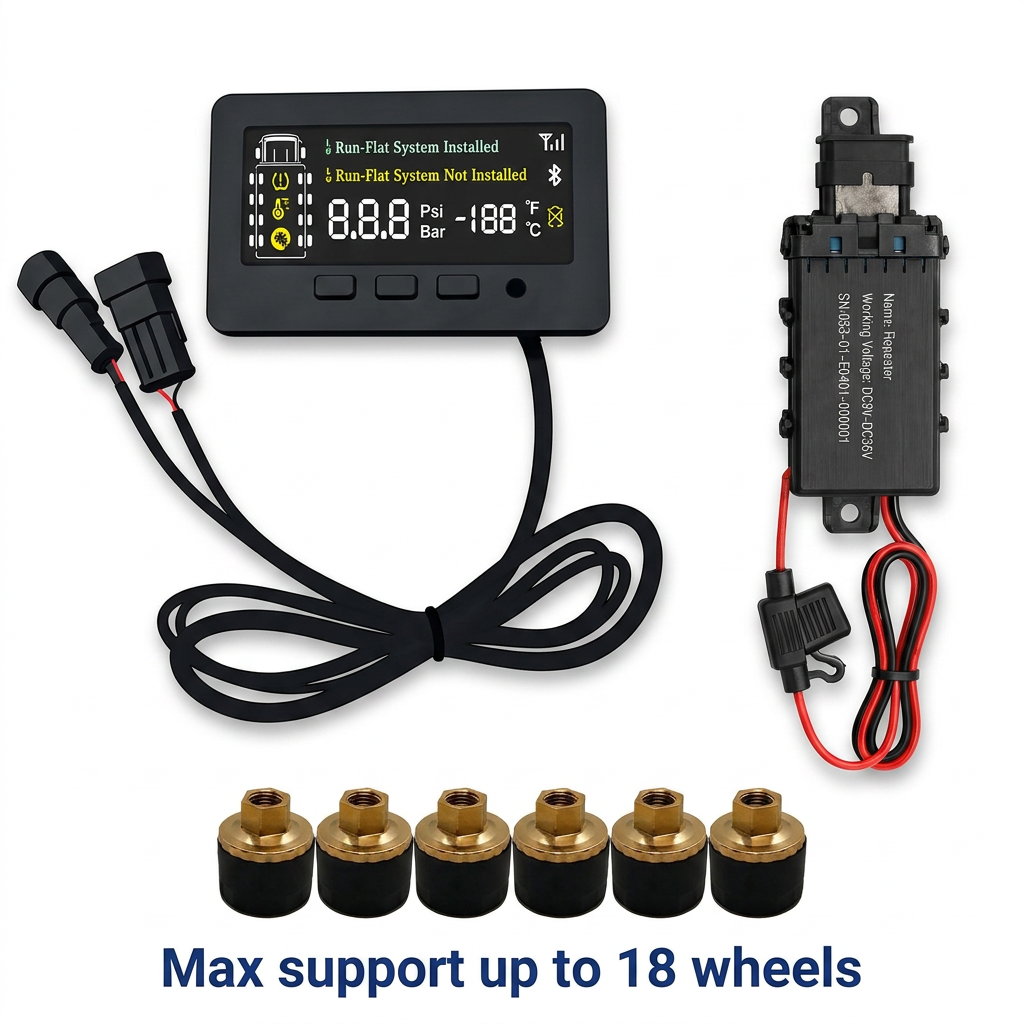
Fast valve-cap retrofit and convenient replacement for trailer fleets.
Trailer TPMS Technical Specifications
| RF Frequency | 433.92 MHz |
|---|---|
| Pressure Range | 0–18 bar / 0–261 PSI |
| Pressure Accuracy | ±0.1 bar at 0°C to +85°C |
| Operating Temperature | −40°C to +85°C |
| Internal Sensor Battery | Maxell CR2450HR, 8–10 years |
| External Sensor Battery | Maxell CR1632HR, 1–2 years |
| CAN Receiver Limit | TDS200 CAN J1939 solution supports up to 18 wheels |
| Display Solution Limit | TDS300 RS232/RS485 display solution supports up to 46 wheels |
| Repeater Planning | 6–14 wheels normally use 1 repeater; more than 14 wheels normally use 2 |
| Pairing Alternatives | Activation tool, QR scan or sensor ID input where supported |
| Trailer Exchange | Smart repeater automatically matches the connected trailer sensor group to the truck display |
| Receiver & Display OTA | Both the receiver and display support OTA upgrades through the applicable upgrade method |
For the general commercial-vehicle system, see the truck TPMS system for commercial vehicles. For BLE gateway and passive broadcast projects, explore Bluetooth TPMS sensors for fleet integration.
FREQUENTLY ASKED QUESTIONS
Trailer TPMS System FAQ
How does trailer exchange pairing work?
Each interchangeable trailer has its own TPMS sensors and smart repeater. When the tractor connects to a different equipped trailer, the truck TPMS display automatically matches that trailer sensor group.
Is a repeater required for every trailer?
A standard repeater is selected according to vehicle length and signal conditions. Each interchangeable trailer that requires automatic trailer exchange or trailer swap matching should use the applicable smart repeater.
How many trailer wheels can be monitored?
The TDS200 CAN J1939 solution supports up to 18 wheels. The TDS300 RS232/RS485 display solution supports up to 46 wheels. The selected receiver limit must match the project configuration.
Can one truck work with Trailer A Trailer B and Trailer C?
Yes. The same tractor-side display can automatically match Trailer A, Trailer B or Trailer C through the smart repeater installed on each equipped trailer.
Is manual pairing required after a trailer swap?
No. With the smart repeater configuration, the truck TPMS display automatically matches the connected trailer sensor group after a trailer exchange or trailer swap.
Does the system support CAN J1939?
Yes. The TDS200 CAN J1939 receiver supports up to 18 wheels. CAN data definitions and vehicle integration requirements should be confirmed for the project.
Can trailer data be sent to a fleet platform?
Yes. A compatible CAN J1939, RS232 or RS485 receiver or display configuration can forward pressure, temperature, sensor ID and alarm data to supported fleet hardware.
How are sensor IDs assigned to wheel positions?
Sensor IDs can be assigned through the activation tool, QR scan or manual ID input where supported by the selected configuration.
What happens when the tractor disconnects from the trailer?
After the tractor connects to another equipped trailer, the display automatically identifies and matches the new trailer sensor group through its smart repeater.
PROJECT INQUIRY
Build the Right Trailer TPMS for Your Fleet
Tell us the trailer type, wheel quantity, sensor preference, exchange or swap workflow and required CAN J1939, RS232 or RS485 interface.