
Quick answer: Replace a TPMS sensor when diagnosis confirms a depleted sealed battery, damaged electronics, or an unserviceable assembly. A warning light alone is not proof: check tire pressure, leaks, sensor data, vehicle compatibility, and relearn status first.
TPMS sensors are mounted inside the tire or on the valve stem outside it. They help monitor tire pressure and, on supported systems, tire temperature and sensor status. Like other vehicle components, they can fail because of battery depletion, valve-stem damage, impact, corrosion, or communication faults.
A TPMS warning light does not automatically mean the entire sensor needs replacement. Diagnose the cause before installing a new TPMS sensor.
Common Signs That a TPMS Sensor May Need Replacement
When any of the following occurs, the TPMS sensor may need to be inspected or replaced:
- The TPMS warning light stays on even after tire pressure has been corrected;
- A wheel position shows no data, or displays abnormal data;
- Sensor signals are intermittently interrupted or frequently lost;
- The sensor battery is low, or the sensor can no longer transmit a signal;
- The valve stem, seals, nut, or sensor housing is damaged;
- The sensor cannot be activated, programmed, or relearned with a compatible TPMS tool;
- The sensor ID is missing, invalid, or inconsistent with the vehicle configuration.
These symptoms do not prove the sensor itself is damaged. Check tire pressure, the receiver, wiring, vehicle communication, and relearn status as appropriate.
Is It the Battery, Valve Stem, or Complete Sensor?
Sensor battery failure
Most TPMS sensor batteries are sealed inside the sensor and cannot normally be replaced separately. Once a sealed battery is depleted, the complete sensor usually needs replacement. A compatible TPMS tool may help check battery status, sensor ID, pressure, temperature, and communication response. For expected lifespan by type, see How Long Do TPMS Sensors Last?
Valve stem damage
Sometimes the electronics still work, while a valve stem, seal, cap, or mounting component is damaged. If the sensor design allows it, a compatible valve service kit may be enough. Parts must match the sensor model, valve type, and rim.
Complete sensor failure
A complete replacement may be required if the electronics are damaged, water has entered the housing, corrosion is severe, or the sensor cannot communicate. A protocol mismatch can also prevent communication, so confirm frequency, sensor type, ID format, and vehicle compatibility before diagnosing a failed sensor.
How to Install a Replacement TPMS Sensor
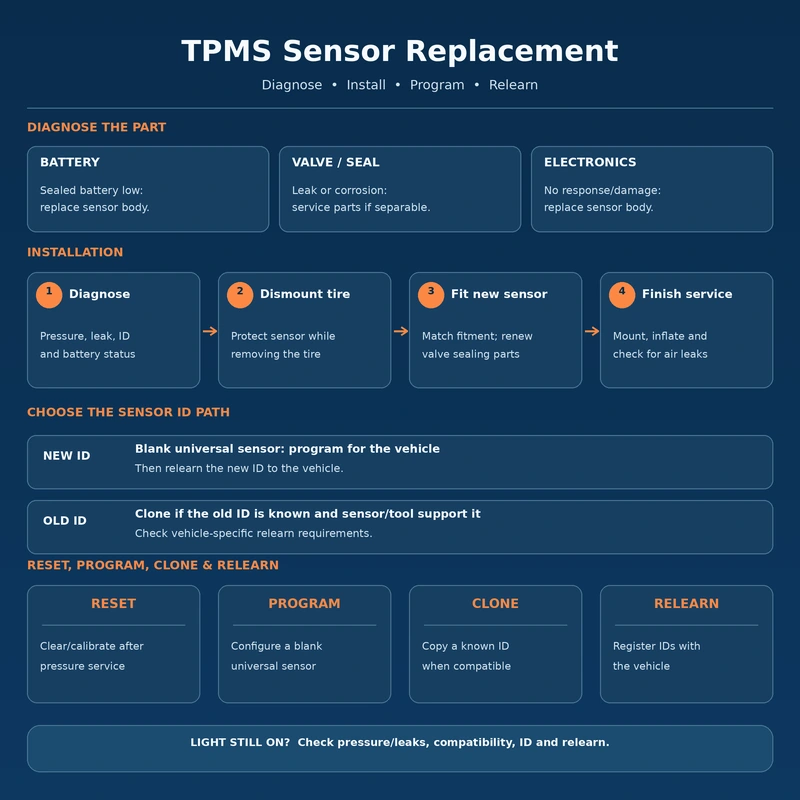
A new sensor may be needed when replacing tires, servicing wheels, or resolving a confirmed sensor fault. The typical process is:
- Confirm the vehicle, model year, sensor type, and wheel position;
- Program or clone a compatible replacement sensor before fitting it when required, and verify that it responds to the appropriate tool;
- Deflate the tire following the correct procedure and demount the tire from the rim;
- Remove the old sensor and inspect the valve hole, rim, and mounting area;
- Install the new sensor using the correct seals, nut, and mounting parts;
- Tighten the mounting parts to the sensor manufacturer's specification;
- Remount the tire, inflate it to the specified pressure, and check for leaks;
- Complete the vehicle's TPMS relearn procedure.
Internal and valve-mounted sensors usually require tire demounting; some external sensors can be replaced without removing the tire. Follow the installation method specified for the sensor and vehicle.
Why Do Universal TPMS Sensors Usually Need Programming?
Universal TPMS sensors may cover multiple vehicle applications, but they do not automatically work with every vehicle. A blank universal sensor usually needs programming for the vehicle application, frequency, communication protocol, and sensor ID before installation. Compare Universal TPMS Sensors vs OEM TPMS Sensors for replacement choices.
A TPMS Program Tool can write the required configuration to the sensor and verify that the sensor responds correctly. Depending on the sensor and tool, programming may be done through a vehicle model database, manual selection, automatic identification, or sensor-to-sensor transfer.
The specific procedure depends on the sensor manufacturer and programming tool. Even if the sensor frequency is correct, it may still be unable to communicate with the vehicle if the communication protocol or data format does not match.
Is a Relearn Required After Installing a New TPMS Sensor?
In many cases, yes. Programming makes a compatible sensor transmit the data format required by the vehicle; a relearn lets the vehicle or TPMS module associate its ID with the correct wheel position. These are separate operations. For detailed definitions, read TPMS Sensor Relearn vs Programming vs Cloning.
Depending on the vehicle, relearn methods may include:
- Automatic relearn after the vehicle has been driven for a distance;
- Static relearn performed through vehicle controls or a compatible TPMS tool;
- OBD-assisted relearn that writes sensor information into the vehicle module;
- A combination of tool activation, vehicle menu operation, and road driving to complete the relearn.
Some vehicles may not require a separate relearn after recognizing a correctly cloned sensor; other vehicles still need the relearn completed according to the prescribed procedure. In practice, follow the specific vehicle's service instructions.
When Can the Old TPMS Sensor ID Be Cloned?
TPMS sensor cloning copies the original sensor ID, and — where the system supports it — related sensor data, into a compatible replacement sensor. Cloning can usually be considered in the following situations:
- The original sensor ID can still be read;
- Both the vehicle and the replacement sensor support cloning;
- The replacement sensor's frequency and protocol are compatible with the original sensor;
- The existing wheel-position identification relationships are to be preserved;
- The vehicle's relearn procedure accepts the original sensor ID.
On some vehicles, cloning can reduce the need to re-register a new ID, but it is not a shortcut that works for all vehicles. If the old sensor's battery is completely depleted or its ID cannot be read, direct cloning may not be possible. In that case, a new ID may need to be used and a vehicle relearn completed separately.
After cloning, the sensor should still be activated and tested after installation, while checking whether the vehicle displays the correct wheel position, tire pressure, and tire temperature data.
Why Does the TPMS Warning Light Stay On After Sensor Replacement?
If the warning light remains on after installing a new TPMS sensor, possible causes include:
- The sensor has not been programmed as required by the vehicle;
- The vehicle relearn procedure has not been completed;
- The sensor ID was entered incorrectly;
- The sensor was assigned to the wrong wheel position;
- The sensor frequency or communication protocol is incompatible;
- The tire pressure is still outside the specified range;
- The sensor is not transmitting a signal, or its battery is low;
- There is a fault in the receiver, antenna, wiring, or TPMS control module;
- Another warning has been triggered by sensors on other wheels, the spare tire, or the trailer;
- The warning state has not been cleared according to the vehicle's prescribed procedure.
On some vehicles, a TPMS reset can clear the stored warning, but a reset alone cannot fix an incompatible, unprogrammed, or damaged sensor. Use a compatible TPMS tool to check the sensor data and the vehicle's fault codes.
Conclusion
Replacing a TPMS sensor involves more than removing the old part and installing a new one. The correct process may include diagnosis, installation, programming or cloning, and a vehicle relearn.
Before choosing a new TPMS sensor, confirm the vehicle application, sensor frequency, communication protocol, valve stem structure, and the required relearn method. If the original sensor ID can still be read and the system supports cloning, cloning can help preserve the existing configuration. If cloning is not possible, the new sensor usually needs the correct data written into it and a relearn completed by the vehicle.
Understanding the differences between TPMS sensor replacement, programming, cloning, reset, and relearn helps avoid a warning light that keeps coming back and unnecessary repeat replacements.