
Quick answer: In a compatible, initially configured trailer TPMS system, the trailer-mounted Smart Repeater keeps the trailer ID, sensor IDs, and wheel-position relationships together. When the trailer is swapped, it packages the sensor data for the new tractor receiver, allowing that receiver to recognize and display the connected trailer.
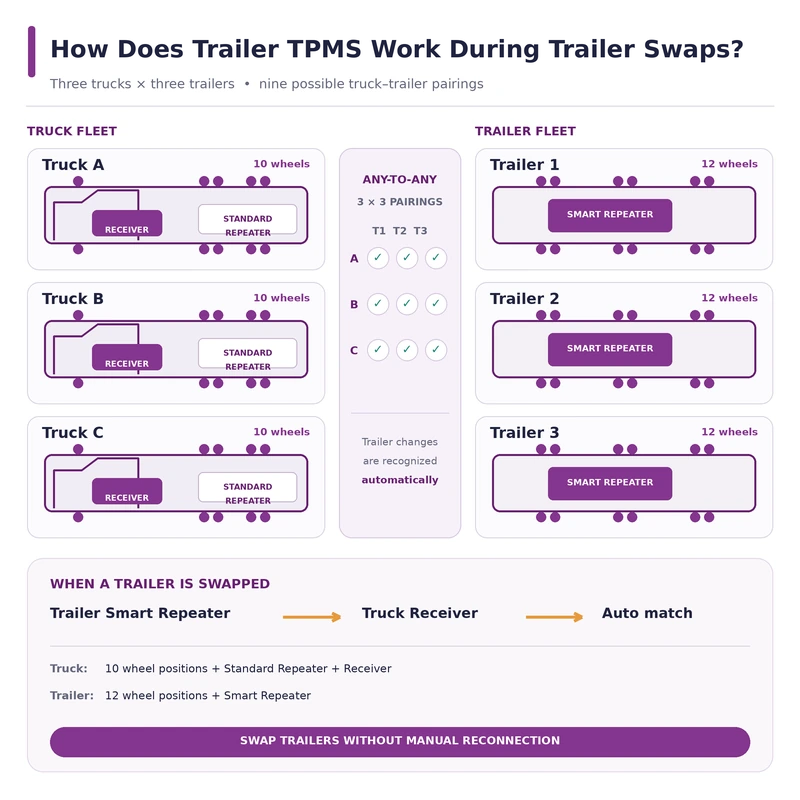
For logistics fleets and semi-trailer tractors, trailer swaps are a common part of daily operations. A single tractor may connect to different trailers, and one trailer may be dispatched with different tractors.
In this situation, a trailer TPMS system must monitor tire pressure, tire temperature, and sensor status while correctly managing the trailer identity, sensor IDs, and wheel positions. Reconfiguring every sensor after each swap increases maintenance and dispatch work and may cause wheel-position confusion.
Why does a trailer swap affect TPMS?
After a trailer is uncoupled from its original tractor, its tire sensors continue operating. However, the original tractor’s receiver may no longer receive their data, and the new tractor may not yet know which sensors belong to the trailer or their wheel positions.
If the system has no dedicated trailer management mechanism, the following problems may occur after a swap:
- The new tractor cannot recognize the trailer sensors;
- Sensor data does not appear at the correct wheel positions;
- The system needs to perform sensor relearn or reconfiguration again;
- Sensors from other nearby trailers may be misidentified;
- Tire alarms cannot be accurately associated with the current trailer.
The key to a trailer TPMS system is therefore more than receiving wireless signals: it must retain and pass along the trailer ID, sensor IDs, and wheel-position information.
How does the Arvov Smart Repeater support trailer swaps?
The ARVOV Smart Repeater is installed on the trailer and receives and manages data from all TPMS sensors on that trailer. The sensors can transmit tire pressure, tire temperature, battery status, alarm status, sensor ID, and other information to it.
The Smart Repeater aggregates and packages the trailer’s sensor data while retaining the corresponding trailer identity and wheel-position relationships. When a trailer moves to a new tractor, and the system’s required initial configuration or authorization has been completed, the Smart Repeater can pass this data to the new tractor receiver. The new tractor can then identify the connected trailer and display its tire status.
In simple terms, the Smart Repeater centrally manages the TPMS sensor data on the trailer, so the trailer's sensor configuration no longer depends entirely on one fixed tractor.
How Trailer TPMS works during a trailer swap
1. Sensors are installed at the trailer's wheel positions
TPMS sensors are installed at each trailer wheel position and collect tire pressure, tire temperature, battery status, and alarm information. The system establishes the mapping between sensor IDs and wheel positions in advance, including the relevant axle positions.
2. The Smart Repeater is installed on the trailer
The Smart Repeater is fixedly installed on the trailer, receives data from all sensors on the trailer, and organizes it according to the trailer ID and wheel-position relationships. In this way, the sensor configuration can be retained with the trailer instead of being stored only in the tractor receiver.
3. The trailer is uncoupled from the original tractor
When the trailer is uncoupled, its sensors and Smart Repeater retain their configuration. The trailer’s sensor IDs and wheel-position relationships remain available for the next tractor.
4. The trailer is connected to a new tractor
When the trailer connects to a new tractor, its Smart Repeater communicates with the new tractor receiver. It passes the trailer ID, sensor IDs, wheel positions, and current pressure, temperature, and alarm data.
In compatible systems where the initial configuration or authorization has been completed, the new tractor receiver can identify the current trailer based on the trailer information passed by the Smart Repeater, and display the TPMS data of each trailer wheel position in the cab. Here, "automatic identification" means that the system can recognize an already-configured trailer and its sensor data; it does not mean that all devices require no pairing, authorization, or relearn under any circumstances.
5. The receiver displays and uploads the data
After receiving the data organized by the Smart Repeater, the new tractor receiver can display the information on the in-vehicle terminal and can also upload it to the fleet management platform through a gateway. Dispatchers and maintenance teams can view alarm information based on vehicle ID, trailer ID, and wheel position.
A real trailer-swap example: Truck A, Truck B, Truck C and Trailer 1, Trailer 2,Trailer3
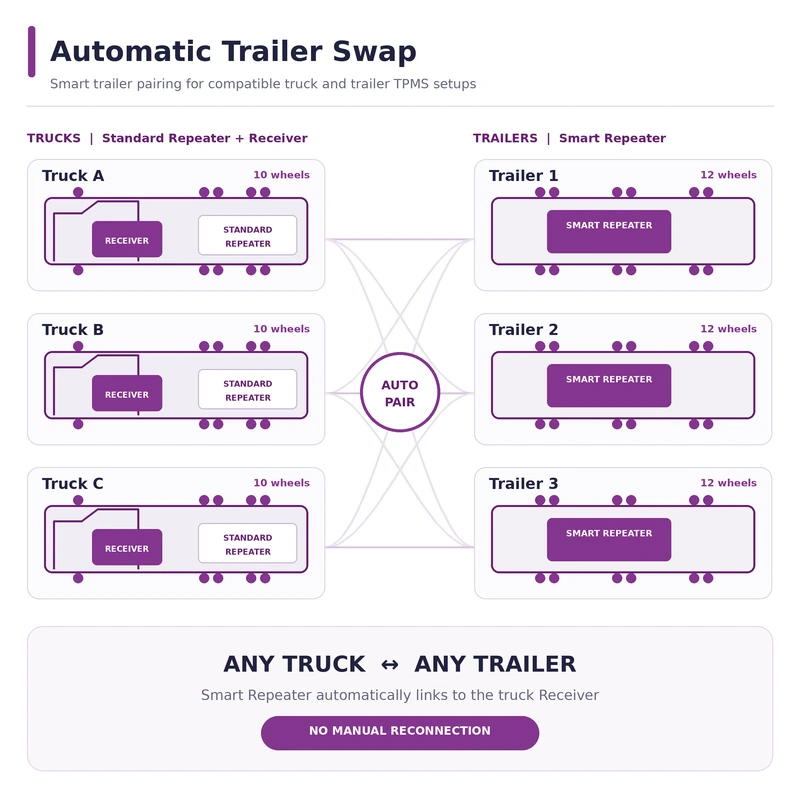
Consider a fleet with Truck A, Truck B, and Truck C and three trailers, Trailer 1, Trailer 2, and Trailer 3. Each trailer has 12 TPMS sensors whose IDs and wheel positions were configured initially.
Step 1: Truck A is connected to Trailer 1
When Truck A connects to Trailer 1, Trailer 1’s ARVOV Smart Repeater receives data from its 12 sensors. It packages the trailer ID, sensor IDs, wheel positions, tire pressure, tire temperature, and alarm status and sends that data to Truck A’s receiver. The driver can view Trailer 1’s tire status.
Step 2: Trailer 1 is swapped to Truck B
Trailer 1 is uncoupled from Truck A and connected to Truck B. The Smart Repeater stays on Trailer 1 and retains its sensor configuration and wheel-position relationships. Once the system’s required initial pairing, authorization, or connection confirmation has been completed, Truck B’s receiver can obtain Trailer 1’s data from the Smart Repeater.
This does not mean that the devices require no pairing at all; it means that during a trailer swap, the driver does not have to manually re-enter Trailer 1's 12 sensor IDs one by one. Whether the trailer ID needs to be confirmed, a configuration selected, or a relearn procedure performed depends on the actual receiver and system design.
Step 3: Truck A then connects to Trailer 2
Truck A then connects to Trailer 2. Trailer 2’s Smart Repeater passes its trailer ID, 12 sensor IDs, wheel positions, and current tire pressure, temperature, and alarm data to Truck A’s receiver. The receiver displays the currently connected Trailer 2 rather than continuing to show Trailer 1’s tire information.
This example shows that the role of the Smart Repeater is to save and aggregate sensor information on a per-trailer basis and, after the trailer changes tractors, pass the corresponding data to the new tractor receiver. It reduces repetitive entry and reconfiguration work; it should not be described as being able to automatically locate devices, require no pairing at all, or need no initial setup in all scenarios.
What’s the Difference Between a Smart Repeater and a Regular Receiver?
A regular TPMS receiver is usually installed on the tractor and is mainly responsible for receiving data from nearby sensors. For fixed vehicle combinations, this approach may be sufficient, but in fleets with frequent trailer swaps, the sensor configuration may need to be relearned or re-bound repeatedly.
The trailer-mounted Smart Repeater centrally manages its sensors, trailer ID, and wheel-position relationships. After a trailer changes tractors, the new tractor receiver obtains that trailer’s data from the Smart Repeater, reducing repeated setup during trailer swaps.
This architecture is especially suitable for:
- Logistics fleets where tractors and trailers are frequently swapped;
- Operating models where one tractor corresponds to multiple trailers;
- Transport companies that need to manage trailer tire data separately;
- Projects that need to connect TPMS data to a fleet platform;
- Application scenarios where sensors should not have to be relearned at every trailer swap.
What Functions Should You Confirm in a Trailer-Swap TPMS System?
When evaluating Trailer TPMS, it is recommended to confirm the following:
- Whether the Smart Repeater is installed on the trailer;
- How many sensors and wheel positions one repeater supports;
- Whether the trailer ID, sensor IDs, and wheel-position information can be saved;
- Whether the configuration is retained after the trailer is uncoupled;
- Whether the new tractor receiver supports identification of configured trailers and data recovery;
- Whether the initial pairing, authorization, or relearn procedure has been completed, and whether confirmation is needed again at each trailer swap;
- Whether sensors from other nearby trailers can be distinguished;
- Whether additional pairing, authorization, or relearn is required;
- Whether the tractor receiver supports display and alarms;
- Whether the fleet platform can be connected via 4G/5G, CAN Bus, J1939, or other interfaces;
- Whether the repeater suits the vibration, rain, mud/sand, and temperature variations on the trailer.
Communication protocols, sensor quantities, wheel-position structures, and receiver configurations may differ between vehicles and projects, so testing with the actual tractor and trailer combinations should be done before batch deployment.
How Can You Avoid Misidentification During Trailer Swaps?
Logistics fleets may park multiple trailers at the same time. If the system determines sensor ownership only by received wireless signals, it may confuse data from nearby vehicles.
Therefore, Trailer TPMS usually needs to identify sensors by combining the trailer ID, sensor IDs, wheel-position configuration, and device binding relationships. The Smart Repeater installed on the trailer helps the system manage sensor data on a per-trailer basis. After a new tractor connects to the trailer, the receiver should receive the corresponding data according to the trailer identity and preset configuration, rather than simply receiving data from all nearby sensors.
Conclusion
The key to trailer TPMS during swaps is keeping the sensor configuration with the trailer and restoring the correct trailer data when it connects to a new tractor.
The Arvov Smart Repeater is installed on the trailer and can receive, aggregate, and package data from all TPMS sensors on the trailer. When a trailer changes tractors, after completing the initial pairing, authorization, or configuration required by the system, the Smart Repeater can pass the trailer ID, sensor IDs, wheel-position information, tire pressure, tire temperature, and alarm data to the new tractor receiver. It helps fleets reduce repetitive entry and reconfiguration, but "automatic connection" does not mean requiring no pairing at all, automatic positioning, or no relearn in all scenarios.
If you are evaluating an ARVOV trailer TPMS solution for trailer swaps, provide the number of tractors and trailers, wheel positions per trailer, swap frequency, existing receiver type, and fleet platform requirements. This helps confirm a compatible Smart Repeater, sensors, and receivers.