
For semi-trailer tractors, trailers, buses, construction vehicles and logistics fleets, a tire pressure monitoring system (TPMS) does more than display tire pressure. It connects tire data to vehicles, drivers, maintenance teams and, when required, fleet platforms. A suitable truck TPMS system can help teams detect slow leaks, unusual tire temperatures and sensor faults earlier. It may also help reduce tire-related downtime and improve visibility into vehicle operations.
1. First, define what the commercial vehicle TPMS needs to do
Commercial vehicles usually have more tires than passenger cars. A vehicle may include a tractor and one or more trailers, while axle layouts, wheel positions, loads and routes vary from fleet to fleet. Choosing a TPMS for semi trucks therefore starts with the fleet’s monitoring goals, not just whether a sensor can measure pressure. Ask:
- Do you need to monitor the tractor, trailer or trailers, and spare tires?
- Do you need pressure, temperature, battery status and wheel position together?
- Do you need rapid-leak, sustained low-pressure and high-temperature alerts?
- Should the data appear on an in-cab display, a fleet platform or at a remote dispatch center?
- Does the project require integration with an automatic tire inflation system, the vehicle’s CAN Bus/J1939 network or existing fleet software?
For local monitoring, a standalone display and receiver may be sufficient. If remote fleet management is required, check the available gateway, cellular communication, CAN Bus/J1939 and data-interface options as part of the complete system design.
2. What data should a truck TPMS system monitor?
A commercial vehicle TPMS should generally cover these data and alert types:
- Tire pressure: Identify low pressure, slow leaks, rapid leaks and differences between tires on the left and right sides.
- Tire temperature: Flag unusual heat that needs inspection. The cause may involve operating conditions, braking or another vehicle issue; a tire-temperature reading alone does not diagnose a brake or bearing fault. Set thresholds to suit the tires, load, environment and duty cycle rather than reusing passenger-car settings.
- Sensor battery status: Give maintenance teams time to plan sensor replacement before battery depletion interrupts data from a wheel position.
- Wheel position and sensor ID: Distinguish the steering axle, drive axles, trailer axles, and left and right wheel positions reliably.
- Alarm status: Cover low or high pressure, rapid air loss, high temperature, sensor faults, lost signals and low battery where supported.
For a real deployment, also confirm whether the truck tire TPMS stores historical readings and supports alert acknowledgement, event records and a documented maintenance response. TPMS provides monitoring and early warning; it does not replace manual inspections, pressure checks or vehicle maintenance.
3. Check communication across the tractor and trailer
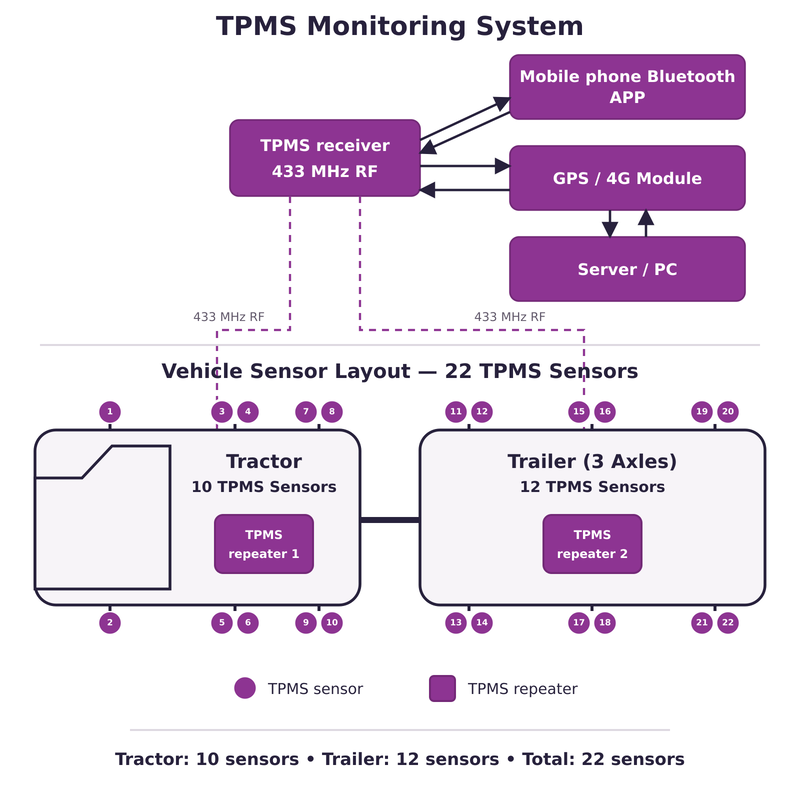
A semi-trailer combination creates a longer wireless path between sensors and receiver. Metal structures can obstruct signals, and trailers may be swapped, detached or coupled to different tractors. A semi truck TPMS should therefore be assessed for wireless coverage, trailer interchange and wheel-position management under the fleet’s actual operating conditions.
During selection, confirm:
- How many wheel positions a single receiver supports;
- Whether tractor and trailer positions can be managed separately;
- Whether trailer configuration is retained and restored after uncoupling;
- Whether repeaters or additional receivers are needed;
- How the system avoids confusing sensors on multiple vehicles parked nearby; and
- Whether the sensors and receiver can withstand rain, mud, salt spray, vibration and temperature changes.
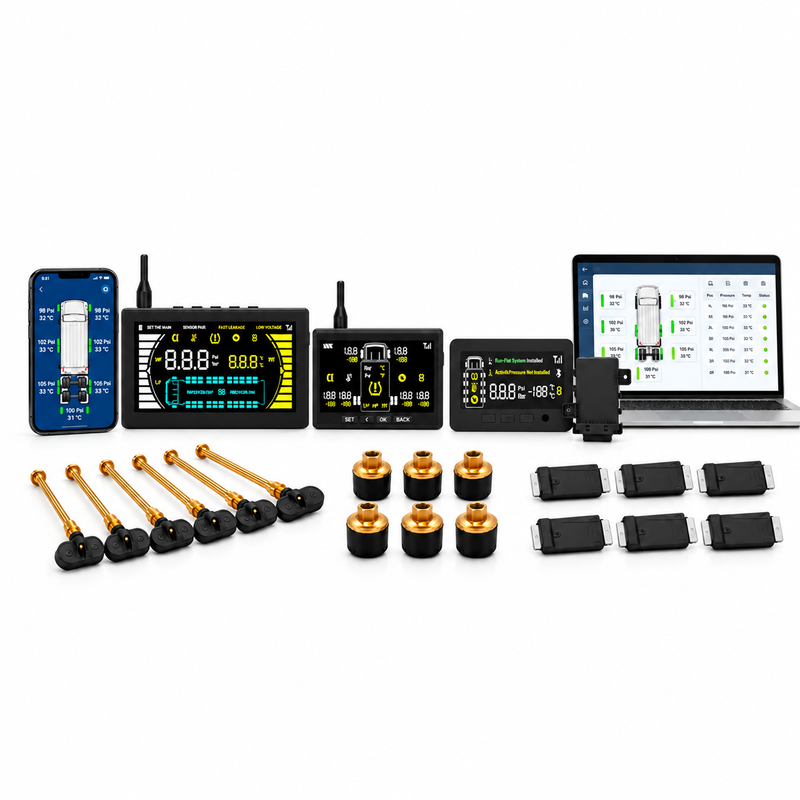
For multi-axle trailers or systems with many wheel positions, choose hardware specifically rated for commercial vehicles and trailers rather than assuming that adding more passenger-car sensors will provide adequate coverage. See ARVOV’s Truck TPMS systems for the product options to evaluate against your vehicle layout.
4. Choose the wireless technology and vehicle interfaces
The link between a tire sensor and receiver usually uses low-power RF or Bluetooth Low Energy (BLE). Conventional RF sensors commonly use 433.92 MHz for the wireless link between the wheel and vehicle receiver. Match the frequency, protocol, data encoding, sensor ID and receiver model: two devices operating at the same frequency are not necessarily compatible.
BLE TPMS can connect to phones, smart terminals, gateways and some electric vehicle systems. It can suit digital integration projects, but Bluetooth support alone is not enough. Check the connection capacity, range, pairing method, data services and vehicle operating environment.
The receiver or gateway may connect to other equipment through the following wired interfaces or protocols:
- CAN Bus: Exchanges data among a receiver, gateway, display and vehicle ECUs.
- SAE J1939: A higher-layer communication protocol used in heavy vehicles, including trucks, buses and construction equipment. Confirm the required PGNs, SPNs, source addresses and data scaling for each integration. Explore the ARVOV CAN Bus J1939 TPMS solution.
- RS232: A point-to-point interface for a receiver and a PC, display, test device or single controller. Check the cable length, electrical environment and application requirements.
- RS485: A differential interface suited to longer wired runs and multi-device arrangements. It may connect a receiver to displays, PLCs, fleet terminals or data-collection devices. RS232 and RS485 describe electrical interfaces; the project must also define the data format and communication protocol. See the ARVOV RS232 and RS485 TPMS solution.
5. Compare sensor mounting and durability
Commercial vehicle TPMS sensors commonly use an internal band-clamp mount, an internal valve-stem mount or an external mount. Internal sensors are more protected during long-term use, but tire removal makes replacement more involved. Valve-stem sensors are relatively straightforward to fit, subject to valve, seal and rim compatibility. External sensors can be quicker to install or replace in some fleet and trailer applications, but their anti-theft design, water resistance and impact resistance deserve careful review.
6. Review alarm logic and fleet platform integration
A practical truck TPMS system should distinguish alert severity instead of simply displaying current readings. A minor pressure deviation might prompt an inspection soon; rapid air loss, excessive temperature or severe low pressure calls for a higher-priority warning. Where supported, review alert thresholds, delay and duration settings, repeated reminders and fault acknowledgement to limit alerts caused by brief fluctuations.
If data must reach a fleet platform, confirm which gateway capabilities the specific project includes, such as 4G/5G connectivity, GNSS, CAN Bus/J1939, RS232 or RS485. Check whether the platform receives the required pressure, temperature, wheel position, alert time, vehicle location and sensor-status fields. A matching connector alone is insufficient: units, timestamps, wheel-position codes and alert rules must also agree between systems.
7. Follow a practical selection process
Evaluate a TPMS for semi trucks and commercial fleets in this order:
- Count the tractors, trailers, axles, spare tires and monitored wheel positions.
- Define the measurements and alert types required.
- Confirm sensor mounting, pressure range and durability requirements.
- Test RF or BLE coverage across the complete tractor–trailer combination.
- Confirm the required CAN, J1939, RS232, RS485 or remote-platform interfaces.
- Ask suppliers for wheel-position setup, sensor relearn, fault diagnosis and after-sales maintenance procedures.
- Before rolling out across the fleet, test on the road under representative loads and temperatures, including trailer uncoupling and reconnection.
Conclusion
Selecting a TPMS for semi-trailer trucks and commercial fleets requires evaluating the complete system, not just comparing sensor prices. Check whether it reliably covers every required wheel position and delivers useful data to the right drivers, maintenance teams and platforms. Sensor durability, tractor–trailer communication, wheel identification, alert priorities, vehicle interfaces and fleet data management all need to work together. Once compatibility is verified from tire to platform, TPMS can support a fleet’s safety processes and preventive maintenance. ARVOV can help review the sensor, receiver and interface requirements for a specific commercial vehicle project.