
With the development of smart vehicles and connected-vehicle applications, Bluetooth TPMS is an option alongside traditional RF tire pressure monitoring. Bluetooth Low Energy (BLE) carries data from tire sensors to compatible phones, in-vehicle terminals or gateways. Depending on the system, those devices can forward tire pressure, tire temperature, battery status, sensor IDs, and alarm information.
However, BLE TPMS is not equivalent to “automatic wheel identification without sensor binding.” The system still needs to confirm sensor protocols, device IDs, wheel-position binding, app permissions, and data interfaces.
How is Bluetooth TPMS different from 433 MHz TPMS?
For the underlying architectures, see Direct TPMS vs Indirect TPMS and the ARVOV TPMS overview.
Traditional direct TPMS typically uses 315 MHz or 433 MHz RF communication. The tire sensor sends data to a dedicated in-vehicle receiver, which then relays it to the instrument cluster or vehicle ECU. This is a mature approach used in many OEM vehicle systems; sensor power use depends on the device design and transmission schedule, but the sensors usually cannot be scanned directly by an ordinary phone; a matching receiver and communication protocol are required.
Bluetooth TPMS sensors, by contrast, use 2.4 GHz BLE communication. Sensors can send data through advertising packets, or establish a BLE connection with a phone, gateway, or dedicated receiver when needed. Their advantage is direct integration with compatible digital devices: users can view data with an app, and project teams can develop gateways, cloud platforms and remote monitoring functions using the documented protocol.
But the two cannot be treated as interchangeable simply because both are “wireless.” 433 MHz and BLE differ in frequency band, modulation, message format, data protocol, and receiving equipment. Even if two sensors are both labeled “TPMS,” that does not mean they can use the same app or receiver.
What data does a BLE sensor broadcast?
The broadcast content of a Bluetooth TPMS sensor depends on the manufacturer’s protocol and product design. Common fields include:
- Sensor ID or MAC-related identification information;
- Current tire pressure and pressure unit;
- Tire temperature;
- Battery voltage, charge level, or low-battery status;
- Motion/stationary state, acceleration, or wake-up state;
- Data sequence number, timestamp, alarm status, and validation fields.
Not all products expose every field, and not all alarms are judged directly by the sensor. For example, low-pressure, high-pressure, and high-temperature alarms may be generated by the sensor, or may be calculated by the app, gateway, or customer platform based on thresholds, duration, and vehicle operating conditions. Wheel position is also not information the sensor inherently knows; it is established through app configuration, QR-code binding, or a learning process after installation.
Note that some BLE devices may use random addresses or privacy addresses, so MAC-related information is not necessarily a stable business ID. Real projects should confirm the manufacturer-defined sensor serial number, short ID, or protocol device identifier.
TPMS temperature is usually the temperature measured at the sensor inside the tire, which may approximate tire-cavity conditions; it cannot be directly equated with tread, brake, or wheel hub bearing temperature, nor can it be used alone to diagnose braking system faults.
BLE devices can provide basic data through advertising packets and, when a connection is supported, can provide additional data, configuration items, or diagnostic information through GATT services and characteristics. Before developing a customer system, confirm the broadcast format, Service UUID, Characteristic UUID, units, byte order, and checksum rules — do not develop based only on the sensor’s name.
Do Android and iOS support Bluetooth TPMS?
Both Android and iOS support BLE scanning and communication with BLE peripherals. Android apps can use Bluetooth LE scanning APIs to read supported advertising data; iOS apps can use Core Bluetooth to discover compatible peripherals and access permitted advertising and service data. Therefore, developing an Android Bluetooth TPMS app is feasible, and iPhones and iPads can also be used with compatible Bluetooth TPMS sensors.
But “the phone supports BLE” does not mean it supports all BLE TPMS. The app still needs to recognize the manufacturer’s broadcast format or GATT protocol; Android needs to handle Bluetooth, nearby-device, or location-related permissions depending on the OS version, and iOS is also subject to Bluetooth permission, background operation, and system scanning policy restrictions. So an app being able to scan the device does not mean it can continuously receive all broadcast data in the background. For platform requirements, refer to Android Bluetooth permissions and Apple Core Bluetooth background processing.
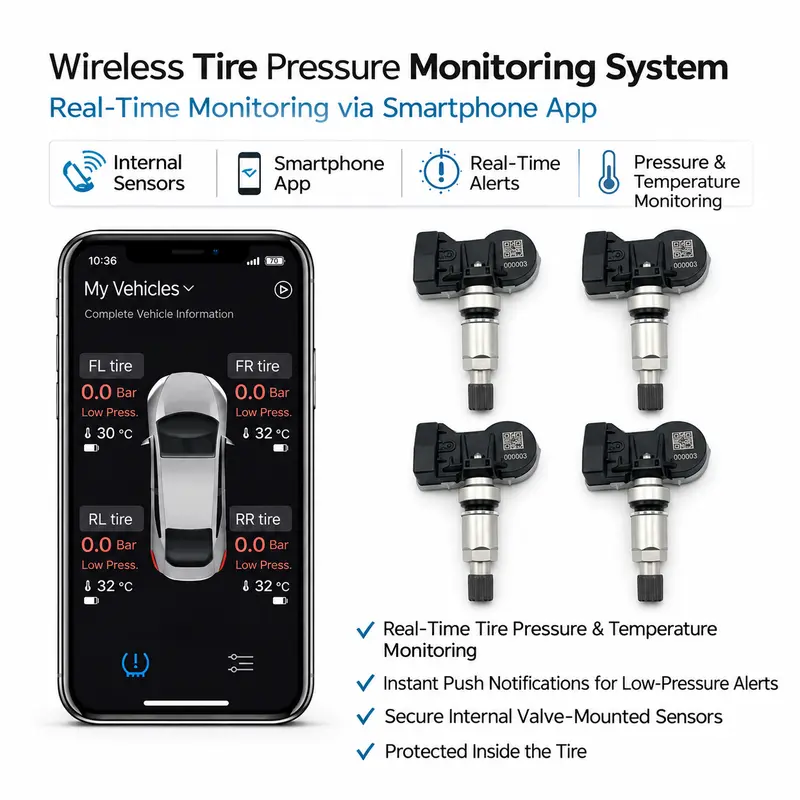
Do all TPMS sensors support Bluetooth?
Not all TPMS sensors support Bluetooth. Some sensors use BLE, while others use 315 MHz, 433 MHz, or other proprietary RF technologies. This depends on the vehicle model, sensor model, and application scenario.
QR-code scanning, sensor IDs, and wheel-position matching
The fact that a BLE sensor supports QR-code scanning does not mean configuration can be skipped entirely. The QR code usually contains the sensor serial number, short ID, production information, or product model. After scanning, the app can cross-check the ID in the QR code against the BLE broadcasting device actually detected, and then bind the sensor to the front-left, front-right, rear-left, rear-right, or trailer wheel position.
A typical matching flow is: scan the QR code or enter the ID, have the app search for BLE broadcasting devices and validate the ID, protocol, and model, then bind the wheel position and set alarm thresholds, and finally synchronize to the gateway or customer platform.
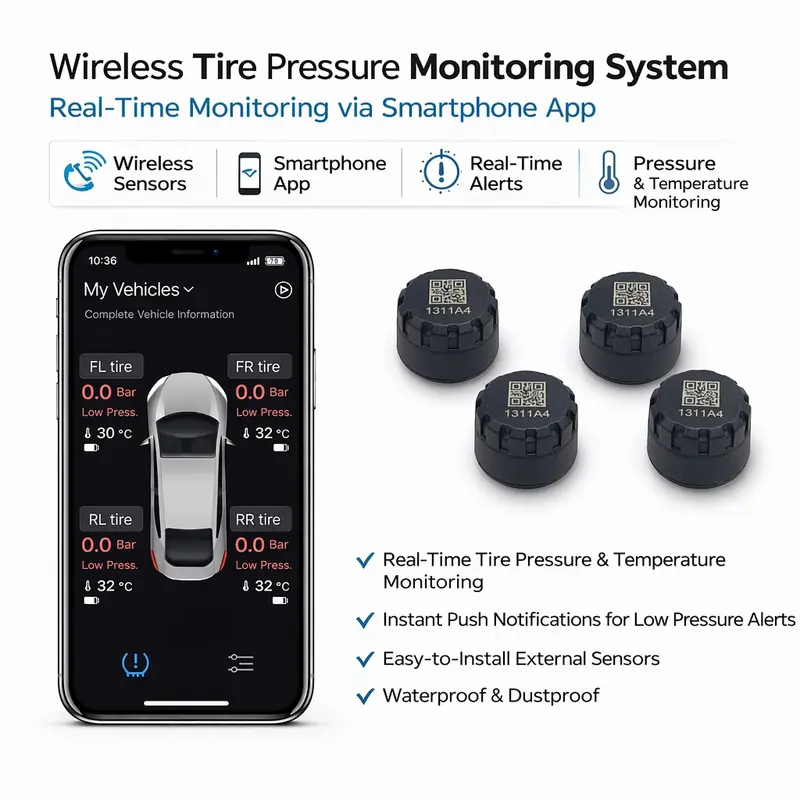
If wheel-position binding is skipped, the system may only show “a sensor was found” without being able to tell which tire the data comes from. ID management is especially important for multi-wheel-position commercial vehicles, trailers, or fleet projects.
App, 4G gateway, and customer-owned system integration
For product specifications and compatible system options, see ARVOV’s Bluetooth TPMS solution and Truck TPMS systems.
For individual vehicle owners, an app can directly scan BLE sensors and display tire pressure, tire temperature, battery level, and alarm information. For fleet or industrial projects, one possible architecture is “BLE sensors + in-vehicle gateway + cellular connection + cloud platform.” A compatible gateway receives data from configured sensors, organizes messages according to vehicle number and wheel-position relationships, and uploads them to the server over the cellular network.
When integrating with a customer-owned system, confirm the BLE broadcast or GATT protocol, ID and wheel-position encoding, pressure and temperature units, MQTT/HTTP/TCP/API interfaces, and offline caching, retransmission, timestamps, authentication, and encryption methods. Multi-vehicle or trailer projects should also pay attention to device whitelists, vehicle binding, signal strength, and offline alarms. Only with unified data formats and wheel-position logic can BLE TPMS be reliably connected to the customer platform. For commercial vehicle data transport, review the project’s CAN Bus/J1939 or RS232/RS485 interface requirements separately from the BLE sensor link.
How should the data update frequency be understood?
The “update frequency” of Bluetooth TPMS includes three frequencies — sensor sampling, BLE broadcasting, and app/gateway upload — which are not necessarily the same. For products supporting motion/stationary modes, the sensor can increase the update frequency when the vehicle is moving and reduce it when stationary, balancing timeliness against battery life. The more frequently BLE broadcasts, the faster data updates, but power consumption may increase; the gateway, meanwhile, can upload in real time, periodically, or only when an alarm occurs.
Therefore, during selection, confirm the motion/stationary modes, alarm priority, gateway upload cycle, offline caching, and app background refresh mechanisms, rather than only asking “how often does it update in seconds.”
Why doesn’t a BLE sensor mean no pairing is needed at all?
BLE is just a wireless communication method, not a unified TPMS application protocol. Different brands may use different broadcast fields, manufacturer data formats, Service UUIDs, encryption methods, and alarm rules. Even if a phone can scan a sensor, that does not mean the app can correctly parse the tire pressure, let alone automatically determine the wheel position.
So Bluetooth TPMS selection should simultaneously confirm the sensor protocol, app compatibility, QR-code or ID learning method, wheel-position configuration, number of gateways, data update strategy, and customer platform interfaces. For replacement projects, also confirm whether the original vehicle uses BLE; a standard 433 MHz RF sensor cannot directly replace a BLE sensor. For a model-specific example, see the ARVOV Tesla TPMS solution.
ARVOV Protocol References and Applicability
The Truck Bluetooth TPMS protocol (PDF) and Car Bluetooth TPMS protocol (PDF) document advertising fields for compatible ARVOV sensors, including pressure, temperature, sensor voltage, status and software-version data. Use the document that matches the supplied sensor; the two formats should not be assumed interchangeable.
These public files do not identify a document revision number or a complete sensor-model and firmware compatibility list. Before implementation, request the applicable protocol revision, confirm the sensor model and firmware, and validate sample packets with ARVOV technical support. Protocol packet definitions alone do not establish battery life or the reporting interval of every BLE sensor configuration.
Public documentation checked: 6 October 2026. This records a document check, not a new hardware test or protocol release.
Conclusion
Both Bluetooth TPMS sensors and traditional 433 MHz TPMS can monitor tire pressure, but they suit different system architectures. BLE can simplify integration with compatible phone apps, smart devices, gateways and customer-owned platforms; 433 MHz is more common in traditional in-vehicle receivers and OEM RF systems. When choosing Bluetooth TPMS sensors, focus on the data protocol, Android/iOS support, QR-code and ID matching, wheel-position management, update frequency, and gateway interfaces. Only after end-to-end compatibility verification from sensor to app, gateway, and cloud platform can a BLE TPMS solution deliver the intended digital monitoring functions.