
A tire pressure monitoring system (TPMS) is an electronic system that monitors tire conditions and alerts the driver or a fleet management platform. It primarily monitors tire pressure and, depending on the system, may also provide tire temperature, sensor battery status and wheel position. When it detects low pressure, rapid air loss, excessive temperature or a sensor fault, it can send an alert through the instrument cluster, a dedicated display, a mobile app or a fleet platform. For the difference between the two detection methods, see direct vs indirect TPMS.
What components make up a TPMS?
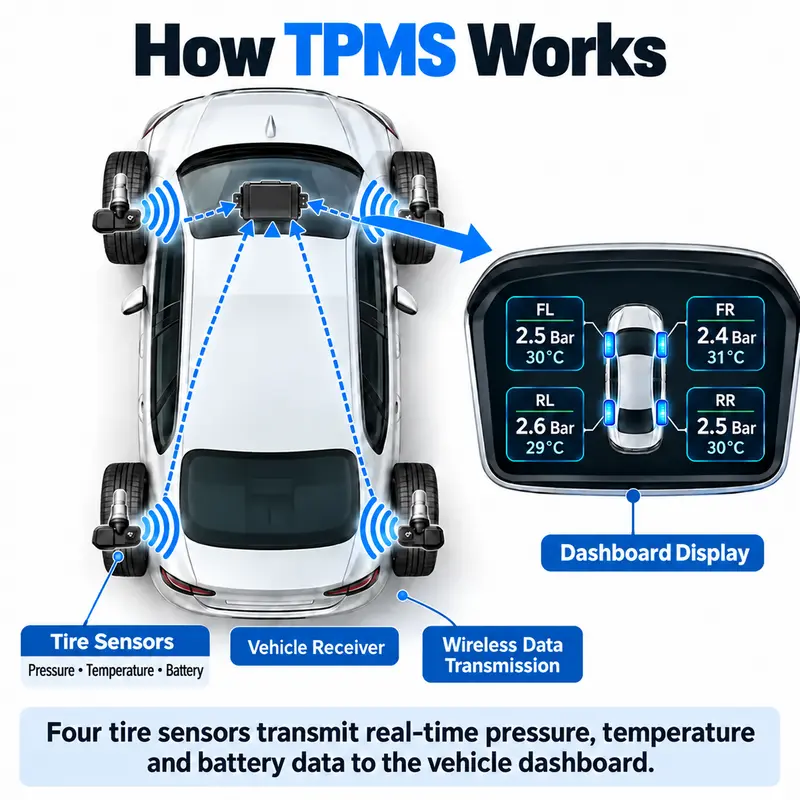
A direct TPMS system typically involves four components:
- Tire sensors: Installed inside the wheel rim, at the valve stem or externally. The sensors measure pressure and temperature and monitor their own battery status. Some models also support acceleration sensing, sensor IDs and identification of the installed wheel position.
- Wireless receiver or gateway: Receives data from the sensors, identifies each sensor, decodes the data, evaluates abnormal conditions and forwards information to a vehicle controller, display or telematics device.
- Display and alert unit: Presents tire pressure, temperature, wheel position and alerts on the dashboard, a separate display, a mobile app or a fleet management platform.
- Vehicle communication interface: Passenger vehicle systems may exchange information with the instrument cluster through an ECU or CAN network. Commercial vehicle systems often connect to the vehicle network, gateway and telematics platform through CAN or SAE J1939.
How are pressure, temperature, battery status and alerts transmitted?
Consider a direct TPMS system. Each wheel sensor periodically collects tire pressure, tire temperature and battery voltage or battery level information. It creates a data message that contains the sensor ID, measured values, status flags and error-checking information. In a common 433.92 MHz RF TPMS, the sensor sends this message to an onboard receiver using a low-power radio signal. The receiver demodulates and checks the message, identifies the wheel position and forwards the information to the instrument cluster and control units over the vehicle CAN network or another interface.
Bluetooth TPMS uses Bluetooth Low Energy (BLE) to communicate wirelessly with mobile phones, dedicated receivers, smart gateways and some electric vehicle systems. BLE can simplify integration with digital devices. Direct vehicle integration still depends on the vehicle’s Bluetooth protocol, pairing method and data interface; RF and BLE systems are not interchangeable simply because both are wireless.
CAN, J1939, RS232 and RS485 are wired communication interfaces or protocols, not wireless transmission methods. Typically, the TPMS sensor first sends its data by RF or BLE to a receiver or gateway. That device then outputs the data over the appropriate wired interface. In a commercial vehicle, CAN messages using SAE J1939 conventions may carry tire pressure, temperature, alerts and wheel position to the cluster, body controller, gateway or telematics terminal. Depending on the design, the sensor, receiver, vehicle ECU or fleet platform may decide when to trigger an alert based on thresholds and how long a condition persists.
Where are RF 433.92 MHz, BLE, CAN/J1939, RS232 and RS485 used?
- RF 433.92 MHz: Common in conventional direct TPMS for the wireless link between a wheel sensor and onboard receiver. It is a mature, low-power option, but operating frequency, communication protocol, encoding and sensor ID must match the receiving system.
- BLE: Bluetooth Low Energy provides wireless communication for phones, smart devices, gateways and certain electric vehicle applications. It supports software integration and additional data functions, but Bluetooth version, service protocol, pairing logic and vehicle compatibility must be checked.
- CAN Bus/J1939: Provides wired data exchange between a receiver or gateway and vehicle controllers. CAN is common in passenger cars and other automotive electronic systems. SAE J1939 is a higher-layer protocol widely used in truck TPMS, buses and construction machinery, supporting communication among multiple ECUs, diagnostics and fleet data integration.
- RS232: A point-to-point serial interface often used to connect a TPMS receiver to a computer, display, test device or one external controller. It is straightforward for short, one-to-one connections, but is generally less suitable than RS485 for longer cable runs, electrical noise and multiple devices on one bus.
- RS485: A differential serial interface that supports longer connections and networks of multiple devices, with generally better noise immunity than RS232. It can connect a TPMS receiver to an industrial controller, fleet terminal, PLC, display or remote data collector. The project must still define its communication protocol, baud rate, data format and device roles. RS232 and RS485 specify electrical interfaces and are not equivalent to CAN or J1939.
How does passenger vehicle TPMS differ from commercial vehicle TPMS?
A passenger vehicle usually has four or five monitored wheel positions. Its main functions are low-pressure alerts, tire temperature display where supported, sensor identification and dashboard notifications. System design also emphasizes size, power use, cost, comfort and compatibility with the original vehicle electronics. Replacement choices may include OEM TPMS sensors, subject to model and protocol compatibility.
A commercial vehicle may include a tractor, trailer, spare tire or multiple axles. It has more monitored wheel positions, and tire loads and operating conditions are more complex. In addition to monitoring pressure and temperature, a commercial vehicle TPMS may need multi-wheel management, trailer identification, longer-range communication, repeaters, low-battery alerts, fleet monitoring and, depending on project requirements, the applicable CAN Bus/J1939, RS232 or RS485 outputs. Sensor pressure range, protection rating, vibration resistance and mounting method also matter when selecting a system.
How do you choose the right TPMS system?
Start with the vehicle type, number of wheel positions and whether a trailer is involved. Determine whether the system must connect to the vehicle’s CAN/J1939 network, an RS232 or RS485 interface, or a remote fleet platform. Next, decide which information is needed: a low-pressure alert only, or pressure, temperature, battery status, wheel position and historical records. Then check the wireless technology, operating frequency, communication protocol, sensor pressure range, installation method, output interface and sensor relearn procedure.
For a passenger vehicle sensor replacement, verify the model year, sales market, 315 MHz or 433.92 MHz frequency, sensor ID and pairing or relearn method. For a commercial vehicle or fleet project, also confirm the J1939 messages, CAN gateway interface, RS232/RS485 data format, trailer management and platform protocol. Choosing a suitable TPMS system means ensuring that the sensors, wireless link, vehicle network, serial interfaces, displays, alerts and service procedures all work together. ARVOV can help review these integration requirements for a specific vehicle or fleet project.