
Quick answer: Programming configures a replacement sensor; cloning copies a compatible original sensor ID; relearning registers the sensor with the vehicle. A reset addresses a vehicle-side warning or setting. The required sequence depends on the vehicle and sensor.
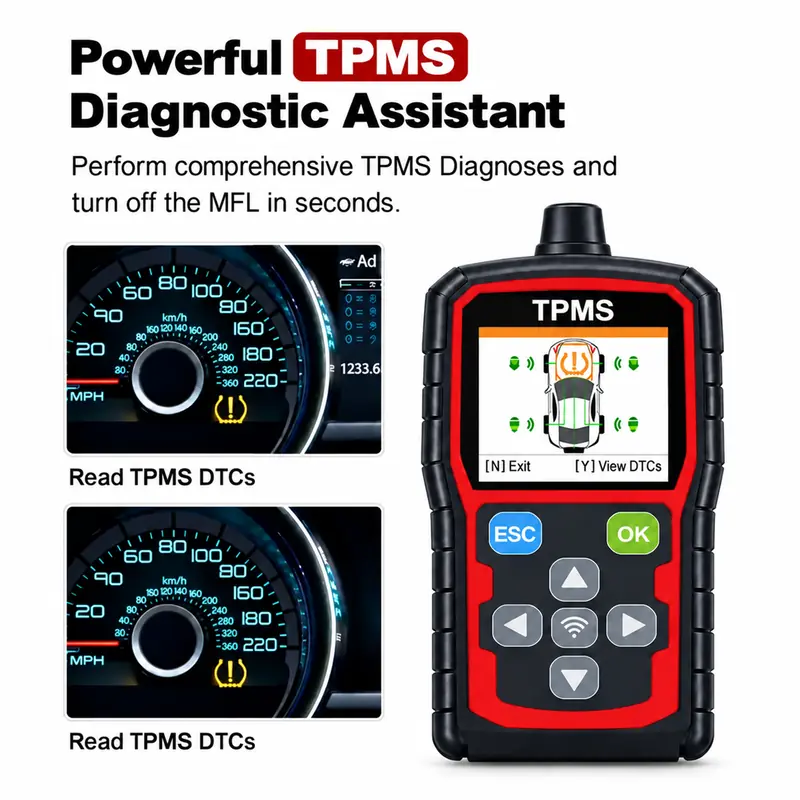
After replacing a tire or TPMS sensor, technicians often encounter three similar terms: TPMS sensor relearn, TPMS sensor programming, and TPMS sensor cloning. Customers may also ask whether a TPMS reset is enough, whether a new TPMS sensor needs programming, or whether TPMS sensors are universal.
These operations serve different purposes. Understanding each one helps you identify the steps a vehicle needs and choose suitable sensors and TPMS programming tools.
TPMS Reset, Relearn, Programming and Cloning at a Glance
| Operation | What changes? | Typical purpose |
|---|---|---|
| Reset | Vehicle-side warning or setting | Clear or reinitialize an alert after the specified checks |
| Relearn | Vehicle’s sensor ID or wheel-position record | Register sensors with the vehicle |
| Programming | Programmable sensor configuration | Match the sensor to a vehicle application |
| Cloning | Replacement sensor ID | Copy a compatible original ID |
TPMS Sensor Reset: Resetting the Vehicle System
A TPMS reset generally means clearing or reinitializing a warning or setting in the vehicle’s instrument cluster or TPMS control module. Depending on the vehicle, adjusting tire pressure, replacing a tire, or resolving a fault may require a reset through the vehicle menu or with a diagnostic tool.
A reset concerns the vehicle system; it does not write an ID or vehicle configuration to a sensor. A reset alone may not make the vehicle recognize a newly installed sensor.
TPMS Sensor Relearn: Registering Sensor IDs and Wheel Positions
A TPMS sensor relearn is the process through which a vehicle recognizes sensor IDs and, where applicable, associates them with wheel positions. Depending on the vehicle, this can involve:
- Automatic relearn;
- Static relearn;
- Driving relearn;
- OBD relearn;
- A relearn initiated with a diagnostic or TPMS tool.
A relearn may be required after rotating tires, replacing a sensor or control module, or losing wheel-position information. Follow the procedure specified for the vehicle; requirements differ by model.
The purpose is to tell the vehicle which sensor is installed and, where applicable, at which wheel. A relearn does not necessarily change data stored in the sensor, so it is different from programming a sensor.
TPMS Sensor Programming: Configuring a Programmable Sensor
TPMS sensor programming writes the configuration a compatible programmable sensor needs to communicate with a target vehicle. Depending on the sensor, that can include an ID, vehicle application, protocol, or other settings. A new unconfigured universal sensor usually needs programming before installation.
The common flow includes:
- Select the vehicle model in the TPMS tool or enter the vehicle information;
- Position or activate the new sensor as instructed by the tool;
- Write the applicable configuration, protocol, and sensor ID;
- Check that the sensor can transmit data normally;
- Install the sensor into the wheel;
- Perform a relearn according to the vehicle's requirements.
Programming methods vary. Some sensors are configured wirelessly, while others need a dedicated interface or tool. Follow the sensor and vehicle manufacturers’ instructions.
TPMS Sensor Cloning: Copying an Existing ID
TPMS sensor cloning reads the original sensor ID or relevant configuration and writes a compatible copy to a new programmable sensor. The replacement then transmits an ID recognized by the vehicle.
Cloning is typically suitable for:
- Replacing a damaged sensor;
- Replacement work where the original sensor ID can be read and a vehicle relearn may be avoided;
- Vehicles or service procedures that call for retaining the original sensor ID;
- Repair shops that want to prepare the sensor before installation.
Cloning does not mean any sensor can be copied to any other sensor. The replacement sensor, vehicle protocol, and tool must all be compatible. Some vehicles still need wheel-position confirmation or a relearn.
TPMS Reset vs Relearn: What Is the Difference?
In practical terms:
- Reset: clear or reinitialize a vehicle-side warning or setting;
- Relearn: register sensor IDs and, where required, their wheel positions in the vehicle;
- Programming: write vehicle-compatible data to a programmable sensor;
- Cloning: copy an existing compatible sensor ID to a replacement sensor.
These steps can occur in sequence. For example, a technician may program a new sensor, install it, and perform a vehicle relearn. With cloning, the technician first reads the original ID and writes it to a compatible replacement, then checks whether the vehicle also requires a relearn or reset.
What Should You Do After Replacing a TPMS Sensor?
When replacing a sensor, check more than whether a reset is needed:
- Whether the new sensor is already pre-programmed;
- Whether the new sensor supports the target vehicle model and communication protocol;
- Whether the sensor needs configuration with a TPMS programming tool;
- Whether the original sensor can be read for cloning;
- Which relearn method the vehicle uses;
- Whether wheel-position information needs to be written via OBD or a diagnostic device;
- Whether a driving relearn or manual reset is needed after installation.
If a correctly programmed sensor is not recognized, check wheel-position registration, the relearn procedure, vehicle compatibility, installation, and the communication protocol before concluding that the sensor is defective.
Are TPMS Sensors Universal?
No. Not all TPMS sensors are universal.
Some universal programmable sensors cover multiple vehicle applications or protocols. “Universal” does not mean automatic compatibility with every vehicle. They generally require vehicle-specific selection, programming, or cloning with a compatible tool.
To determine whether a universal sensor is suitable, confirm:
- Supported vehicle brands, models, and years;
- Wireless frequency and communication protocol;
- Sensor mounting method and valve stem compatibility;
- Whether it is programmable or fixed-configuration;
- Whether ID cloning is supported;
- Whether a dedicated TPMS Program Tool is required;
- Whether the vehicle still requires a relearn.
The benefit of a universal programmable sensor is reduced inventory of fixed-model replacements and more service flexibility. Successful installation still depends on correct tool, protocol, and vehicle matching. Explore the Universal Programmable TPMS Sensor. For a product comparison, see universal vs OEM TPMS sensors and the OEM TPMS Sensors range.
When Is a TPMS Programming Tool Needed?
A TPMS programming tool may be needed for:
- Vehicle model configuration for a new TPMS sensor;
- Writing sensor IDs to programmable sensors;
- Reading original sensor data and performing cloning;
- Activating or testing sensors;
- Triggering the relearn procedure required by the vehicle;
- Diagnosing problems such as sensors not responding, ID mismatches, or wheel-position errors.
When choosing a tool, verify vehicle coverage, supported sensors, programming and cloning functions, activation and diagnostics, and the applicable OBD or other interfaces. Sensor and tool compatibility matters more than a similar product name or appearance. See also the Bluetooth TPMS Program Tool for supported applications.
How Should a Repair Shop Choose TPMS Tools and Universal Sensors?
For a repair shop servicing multiple vehicle makes, an ARVOV TPMS programming tool paired with compatible universal programmable sensors may reduce the need to stock many fixed-model sensors. The tool can support vehicle selection, programming, ID cloning, and certain relearn operations according to the vehicle and tool coverage.
Before purchasing, it is recommended to provide the supplier with the following information:
- The vehicle brands and models mainly served;
- Passenger car, commercial vehicle, or trailer types;
- Whether programming, cloning, or relearn-only is needed;
- The existing sensor brands and the target replacement models;
- Whether OBD, Bluetooth, or other interfaces are needed;
- The planned quantities of tools and sensors to purchase.
With this information, a supplier can confirm compatible sensors, a suitable programming tool, the supported protocols, and the required service procedure.
Conclusion
TPMS reset, relearn, programming, and cloning describe four different operations: resetting a vehicle-side warning or setting, registering sensor IDs with the vehicle, configuring a sensor, and copying an existing compatible sensor ID. Before replacing a sensor, determine whether programming or cloning is appropriate and which relearn procedure the vehicle requires.
TPMS sensors are not all universal. For repair shops, tire service providers, and buyers, checking compatibility among the vehicle, sensor, and tool is essential to efficient installation and troubleshooting.
For help selecting an ARVOV TPMS programming tool or universal programmable sensor, provide the vehicle make, model, year, sensor type, and expected quantities so that a compatible solution can be confirmed.