
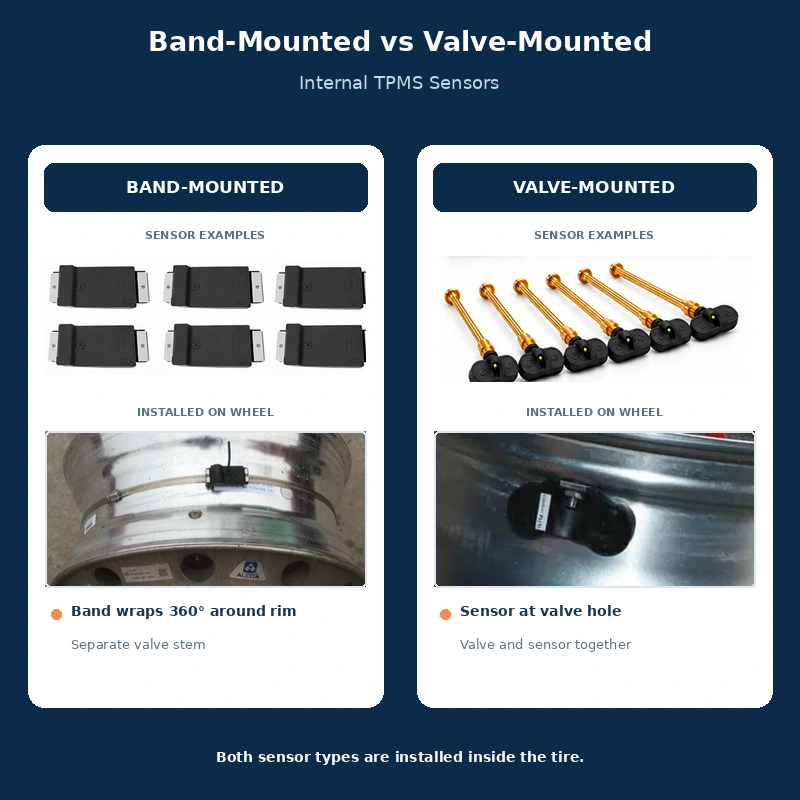
For trucks, buses, trailers, and other commercial vehicles, should you choose banded or valve-mounted TPMS sensors? There is no single answer that fits every vehicle.
Both are internal TPMS sensors: they are installed inside the tire, monitor tire pressure and temperature, and benefit from protection within the tire. The main difference is how the sensor attaches to the wheel. A banded sensor is secured to the rim with a mounting band, while a valve-mounted sensor is integrated with or connected to a dedicated valve stem. The choice depends on rim design, tire construction, valve compatibility, installation method, and fleet maintenance conditions. For a wider comparison, see Internal vs External TPMS Sensors.
1. What Is a Banded TPMS Sensor?
A banded TPMS sensor is installed inside the tire and secured to the rim with a metal or other applicable mounting band. This band-mounted TPMS sensor usually does not require a sensor valve stem to replace the original tire valve. It may suit certain special rims, heavy vehicles, and project-specific installations.
Inside the tire, the sensor has some protection from water, impact, mud, and theft. For certain truck and trailer applications, a correctly fitted band provides a stable mounting method.
However, installing and replacing banded sensors usually requires demounting the tire. Before installation, confirm:
- Rim size and shape;
- The length, structure, and fastening method of the mounting band;
- The correct mounting position of the sensor on the rim;
- Whether there is sufficient clearance between the sensor and the tire/rim;
- Whether tire service tools may collide with the sensor.
Do not assume that every heavy vehicle should use banded sensors. Suitability depends on the wheel rim, tire construction, pressure range, and installation conditions.
2. What Is a Valve-Mounted TPMS Sensor?
A valve-mounted TPMS sensor is also installed inside the tire, but it attaches to a dedicated valve stem or forms a complete assembly with it. The valve stem supports inflation and deflation as well as sensor mounting, hence the name internal valve TPMS sensor.
This solution can suit compatible tubeless commercial tires and rims. Before installation, verify the valve hole, stem dimensions, seals, fastening nut, and rim design against the sensor assembly.
Considerations for valve-mounted TPMS sensors include:
- The valve hole size and shape must be compatible;
- The TPMS valve stem must match the rim and working pressure;
- Seals and mounting parts must be installed correctly;
- Corrosion, looseness, and leaks should be checked;
- The mechanical strength of the valve stem should suit the commercial-vehicle operating environment;
- Replacing valve stem parts does not necessarily mean replacing the complete sensor; this depends on the product design.
A valve-mounted sensor is not automatically easier to install than a banded sensor. Both internal designs generally need access inside the tire; the procedure depends on sensor and rim design.
3. Banded vs Valve-Mounted TPMS Sensors: Key Differences
| Comparison Item | Banded TPMS Sensor | Valve-Mounted TPMS Sensor |
|---|---|---|
| Mounting location | Inside the tire, secured to the rim | Inside the tire, mounted at the valve position |
| Fastening method | Metal band or applicable mounting band | Valve stem, seals, and related mounting components |
| Original valve | Usually can be retained independently, but rim structure needs to be confirmed | Usually replaced by the sensor's dedicated valve assembly |
| Rim requirements | Confirm rim shape, size, and mounting band specifications | Confirm valve hole, valve stem size, and seal compatibility |
| External protection | Installed inside the tire, protected by the tire | Installed inside the tire; protection depends on component design |
| Installation | Usually requires tire demounting and securing the mounting band | Usually requires tire demounting and installing the valve assembly |
| Maintenance focus | Mounting band, mounting position, clearance, and sensor status | Valve stem, seals, corrosion, leaks, and sensor status |
| Typical applications | Special rims, certain heavy vehicles, and project-type installations | Compatible tubeless commercial-vehicle rims |
| Replacement cost | Depends on sensor, mounting band, and tire demounting labor | Depends on sensor, valve stem, seal components, and tire demounting labor |
These mounting methods should not be ranked simply by accuracy. When measurement modules are similar, performance depends mainly on sensor design, calibration, and operating conditions. Mounting primarily changes rim compatibility, installation, and maintenance needs.
4. Which Sensor Is Better for Trucks, Buses and Trailers?
Trucks
For trucks, first check the rim, tire type, recommended pressure, sensor pressure range, and fleet maintenance practices. Either internal design may work. Dual tires, multiple axles, and a high wheel count also require attention to receiver capacity, wireless coverage, and possible repeater use. Explore the Truck TPMS System for Commercial Vehicles.
For a special rim or a project requiring a defined sensor position on the rim, evaluate a banded sensor. If the rim and valve hole have been verified for the dedicated valve assembly, evaluate a valve-mounted sensor.
Buses
Buses usually run for long periods, and fleets may have fixed tire maintenance and spare-parts procedures. When selecting commercial-vehicle TPMS sensors, consider the number of wheel positions, maintenance frequency, sensor replacement method, and consistency of fleet management. See the Bus TPMS System for commercial bus applications.
Do not decide only by ease of installation. Check rim compatibility, pressure range, alarm display, and the later sensor replacement process.
Trailers
For trailers, also consider wireless range, wheel-position management, trailer interchange, and tractor receiver compatibility. Sensor mounting and the Smart Repeater serve different purposes: the sensor determines how it attaches to the rim, while the Smart Repeater aggregates the trailer sensor data and, after required initial setup or authorization, passes and matches the corresponding data to the tractor receiver. Review the Trailer TPMS for Smart Trailer Exchange.
The Smart Repeater therefore does not determine whether a trailer uses banded or valve-mounted sensors. Select the sensors separately according to the rim, tire, and pressure requirements.
Special-Purpose Vehicles
Special-purpose vehicles, including mining, construction, agricultural, and forestry vehicles, may face stronger vibration, impact, mud, or temperature changes. Either mounting method can be evaluated, but select it based on the actual rim, tire, pressure range, and installation environment.
5. Installation and Maintenance Considerations
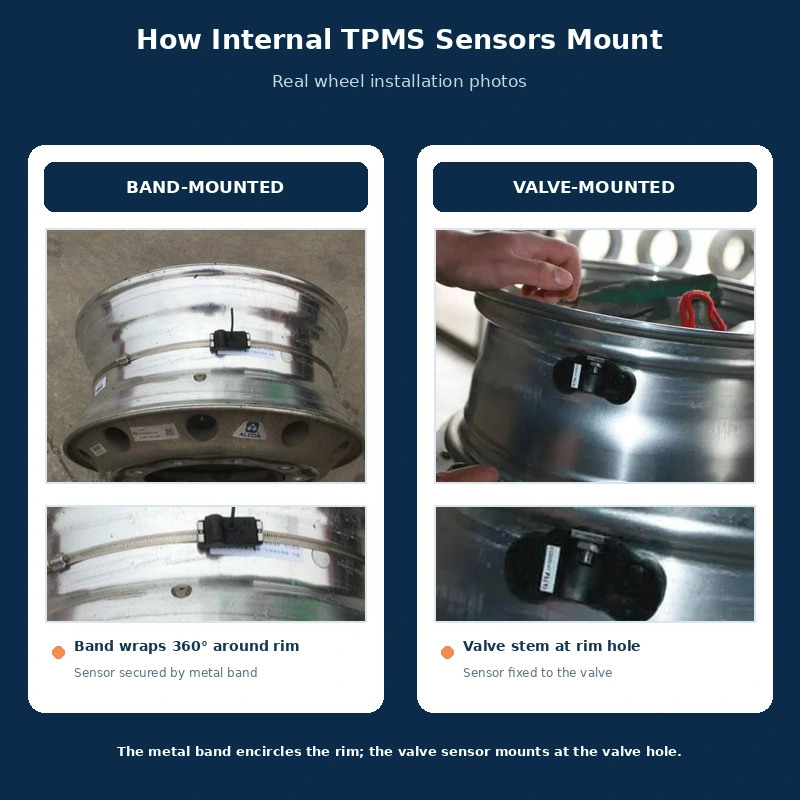
Regardless of which internal TPMS sensor is used, the following steps are recommended:
- Confirm the rim, tire, and valve stem structure before installation;
- Confirm the sensor pressure and temperature ranges;
- Confirm sensor ID and wheel-position configuration;
- For a replacement sensor, match its sensor ID to the corresponding wheel position in the receiver using the app, manual ID entry, or activation tool before mounting it on the rim; no relearn is needed for this receiver pairing step;
- Use suitable tire demounting tools to avoid striking the sensor inside the wheel;
- Correctly install the mounting band, TPMS valve stem, seals, and fastening parts;
- Check airtightness and leaks after installation;
- Complete wheel balancing;
- Test signal, tire pressure, temperature, and alarms in the actual vehicle environment;
- Record the sensor ID, installation date, and corresponding wheel position;
- Inform technicians that a TPMS sensor is installed inside the tire when tire service is performed.
After installation, verify that the receiver shows the paired sensor at the correct wheel position and check pressure, temperature, signal, and alarms. This receiver pairing does not require a relearn. A sensor transmitting a signal alone does not prove correct wheel-position recognition. For the steps involved, see TPMS Sensor Relearn vs Programming vs Cloning.
6. How to Choose Between Banded and Valve-Mounted Sensors?
Choose a banded TPMS sensor when:
- The original tire valve needs to be retained;
- The rim is not suitable for the specified sensor valve assembly;
- The project requires the sensor to be secured at a specific position on the rim;
- The vehicle or rim structure has already been verified with banded installation;
- The fleet has tire demounting, mounting band inspection, and professional maintenance capabilities.
Choose a valve-mounted sensor when:
- The rim and valve hole are compatible with the sensor valve stem;
- The project prefers an integrated internal mounting solution;
- The fleet can maintain the seals, valve stems, and related parts as required;
- The target rim and tire have completed compatibility verification;
- The service network is familiar with TPMS valve stem installation and leak checks.
Choose according to the rim, tire construction, valve-hole dimensions, pressure range, wheel count, receiver compatibility, and installation environment—not the sensor’s appearance or price alone. For service decisions, read When Should TPMS Sensors Be Replaced?.
FAQ
Are banded TPMS sensors installed inside the tire?
Yes. A banded TPMS sensor is installed inside the tire and secured to the rim with an applicable mounting band.
Does a valve-mounted TPMS sensor replace the tire valve?
In many product designs, the sensor is connected to or integrated with a dedicated valve assembly. Whether the original valve is replaced depends on the sensor structure and rim/valve hole compatibility.
Are banded sensors more accurate than valve-mounted sensors?
Not necessarily. Accuracy mainly depends on the sensor hardware, calibration, and operating conditions. The mounting method mainly affects installation, rim compatibility, and maintenance requirements.
Can banded sensors be used on truck and trailer wheels?
They can be used on compatible commercial-vehicle rims, but rim structure, mounting band size, pressure range, and specific installation requirements need to be confirmed.
Which sensor is easier to maintain?
It depends on the vehicle and rim design. Banded sensors require checking the mounting position and mounting band; valve-mounted sensors require focusing on the valve stem, seals, corrosion, and leaks. Expected service life is discussed in How Long Do TPMS Sensors Last?.
Do both sensor types require tire removal?
Usually, installing or replacing either type of internal sensor requires access to the inside of the tire, so tire demounting is often needed. The specifics should follow the sensor structure.
Can both sensors work with the same TPMS receiver?
Only if the frequency, communication protocol, sensor ID format, and receiver are compatible. Identical mounting methods or the same wireless frequency alone do not prove that both sensors can use the same receiver.
Conclusion
Banded and valve-mounted TPMS sensors can both suit certain trucks, buses, trailers, and other commercial vehicles. Their mounting methods, rim requirements, maintenance needs, and fleet applications differ.
A banded design may suit a project that needs a defined mounting position on the rim or where a sensor valve assembly is impractical. A valve-mounted design may suit a rim, valve hole, and dedicated valve assembly that have been verified as compatible. The best choice is the one matched to the actual rim, tire, pressure range, and fleet service process.