
Direct TPMS measures tire pressure with dedicated sensors at the wheels. Indirect TPMS uses vehicle signals to detect changes in wheel behavior that may indicate pressure loss. Both can warn drivers, but they differ in the information they provide and the maintenance they require. For an overview of the sensors and data flow, read what TPMS is and how it works.
A tire pressure monitoring system (TPMS) is an important vehicle safety feature. It monitors for tire pressure problems while the vehicle is in use and warns the driver when a tire loses air or becomes significantly underinflated. This gives the driver an opportunity to respond earlier and supports safer driving and better tire care.
Many markets require specified categories of new passenger vehicles to have TPMS. The vehicles covered, dates and technical requirements vary by jurisdiction. The two main system architectures are direct TPMS and indirect TPMS.
How does TPMS work?
Indirect TPMS
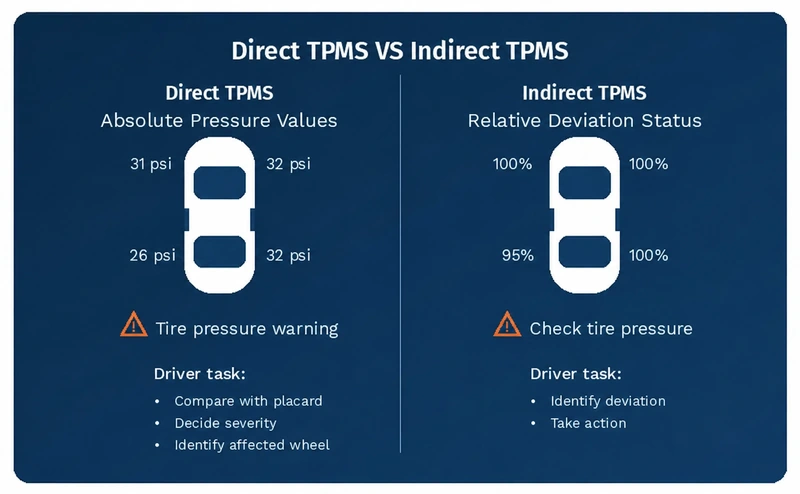
When a tire loses pressure, its effective rolling radius may become smaller. At the same vehicle speed, that wheel may rotate faster than the others. Indirect TPMS uses wheel-speed data, usually supplied by the anti-lock braking system (ABS), and in some designs additional electronic stability control (ESC) data, to identify changes that may indicate a loss of pressure.
The system compares current wheel behavior with a learned reference state. It does not directly measure absolute pressure in psi or bar. Instead, it analyzes relative changes in wheel speed, tire behavior and, depending on the design, other vehicle dynamics signals. Because it infers a possible pressure problem from vehicle behavior rather than measuring pressure at the wheel, indirect TPMS is often described as a passive monitoring method.
After a tire change, wheel rotation or pressure adjustment, the system may need to be reset, initialized or calibrated to establish a new reference state. The procedure and the ability to identify an affected wheel depend on the vehicle manufacturer and system design.
Direct TPMS
Direct TPMS uses a dedicated pressure sensor installed inside or at each wheel. A direct TPMS sensor measures tire pressure and may also measure tire temperature. It processes the data and transmits it wirelessly to the vehicle receiver or control unit.
Depending on the sensor and vehicle design, readings can be transmitted while driving, and some systems may also support pressure or temperature readings when the vehicle is stationary. If the vehicle display supports it, the driver can see actual pressure values and, in many applications, identify the affected wheel. Because direct TPMS actively measures and transmits pressure at the wheel, it is commonly called an active monitoring method.
Both architectures can detect pressure loss and warn the driver under their specified operating conditions. The useful comparison is at the system level: detection behavior, operating dependencies, driver interaction and lifetime costs, as well as whether wheel-mounted sensors are present.
Installation and maintenance differences
Tire replacement, wheel rotation and aftermarket tires can affect either type of TPMS, but the service steps differ.
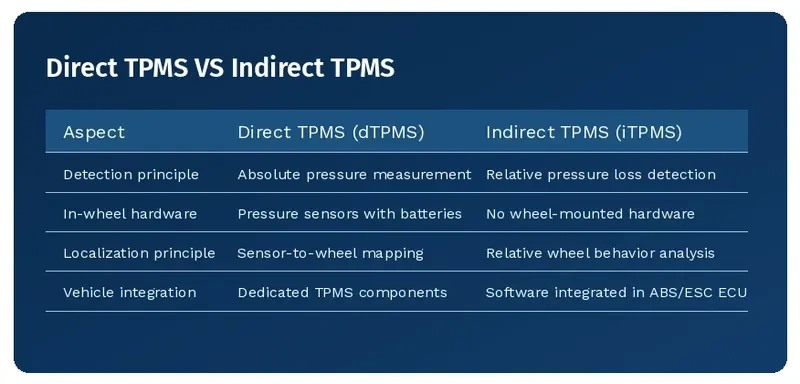
Direct TPMS depends on the condition, compatibility and identification of its wheel sensors. Tire service may involve sensor installation, replacement of a valve or seal, programming or relearn procedures, correct handling and consideration of remaining battery life. When replacing a sensor, a technician should confirm its operating frequency, communication protocol, vehicle fitment, regional specification and relearn method.
Indirect TPMS does not need a dedicated pressure sensor inside each tire. It mainly uses existing wheel-speed sensors and vehicle software to compare wheel behavior. After tire service or a pressure adjustment, a reset or recalibration may be needed. This does not mean any vehicle with ABS can gain indirect TPMS through a simple software update: it needs a compatible ABS/ESC architecture, suitable software and a calibration strategy defined by the manufacturer.
Advantages and limitations
Both approaches have practical advantages. Where the vehicle supports pressure display, direct TPMS can provide the actual value for each monitored tire. It gives the driver more specific information and can identify the affected wheel in many systems. Its trade-offs are additional wheel hardware, sensor compatibility checks, service procedures and eventual battery depletion.
Indirect TPMS can use components already fitted to the vehicle, potentially reducing hardware cost and avoiding a separate pressure sensor at each wheel. Its principal limitation is that it cannot directly measure absolute tire pressure. Detection performance, warning thresholds, calibration and wheel identification vary by vehicle. Tire size and type, wear, vehicle load, road conditions and pressure changes affecting all four tires can also influence calculations based on a reference state.
Neither system removes the need for manual tire checks. Drivers should inspect the tires and use a suitable gauge to set pressure according to the vehicle placard or owner’s manual.
Why does tire pressure monitoring matter?
1. Earlier warning of a developing tire problem
Many vehicle safety systems help reduce the consequences of a collision or loss of control. TPMS plays a different role: it can warn the driver when pressure falls to a level that needs attention. The driver can then slow down or stop somewhere safe, inspect the tire and arrange appropriate service before continuing.
TPMS is an aid, not a substitute for regular tire inspection. After a warning, check the tire and establish why pressure has fallen.
2. Supporting tire service life
Operating at the wrong pressure may cause uneven tread wear, greater tire deformation and heat buildup. Excess pressure may accelerate wear near the center of the tread. Keeping tires at the vehicle manufacturer’s recommended pressure helps them work as designed and supports their service life.
3. Fuel consumption and environmental impact
Underinflation can increase rolling resistance and the energy needed to drive. The U.S. Department of Energy says fuel economy can fall by about 0.2% for every 1 psi drop in average tire pressure across all four tires. The actual effect varies with the vehicle, tires, load, speed, road and driving conditions.
4. Reducing unusual tire and vehicle wear
Incorrect or uneven tire pressure may affect handling, braking balance, steering response and tire wear, and can add load to suspension or related parts. These effects depend on the vehicle, the size and duration of the pressure difference, tire condition, load and road conditions. If TPMS gives a warning, inspect the tires and vehicle to determine the cause.
TPMS regulations and the replacement market
TPMS rules are not identical worldwide. Many markets require defined groups of new passenger vehicles to meet tire pressure monitoring requirements, but vehicle categories, certification dates and performance standards differ.
In the United States, FMVSS No. 138 establishes TPMS performance requirements for covered light vehicles, with full compliance required for covered vehicles produced from September 1, 2007. Other markets, including the European Union, Japan and South Korea, have their own vehicle approval or local requirements. In Taiwan, the Ministry of Transportation and Communications states that new small vehicles produced from July 1, 2016 were required to have a tire pressure monitoring device; the rule did not require already registered older vehicles to be retrofitted. In mainland China, GB 26149-2017 sets performance requirements and test methods for passenger-vehicle TPMS.
As vehicles fitted with direct TPMS remain in service, sensors need replacement when they fail, are damaged during tire service or reach the end of battery life. Passenger-car internal sensors typically have an expected battery life of 3–5 years, although actual life depends on the sensor design and operating conditions. See how long TPMS sensors last for the factors that affect service life.
The two common replacement routes are a vehicle-specific OEM or OE-style sensor selected by confirmed fitment and reference number, and a universal programmable sensor configured for a supported vehicle application, protocol and frequency. ARVOV offers OEM TPMS sensors for confirmed vehicle-specific applications and universal programmable TPMS sensors for supported replacements.
Traditional radio-frequency TPMS applications often use 315 MHz or 433 MHz. Frequencies and communication protocols are not automatically interchangeable: compatibility also depends on the production period, sales market, sensor ID configuration and relearn procedure. Bluetooth Low Energy (BLE) sensors are used in some vehicles and connected-device applications, including certain Tesla applications documented in Tesla’s service instructions. BLE is not a universal replacement for a vehicle’s existing radio-frequency sensor. The replacement must match the original system’s technology and communication requirements.
Summary: choosing the right TPMS approach
The central difference is how a possible pressure loss is detected. Direct TPMS measures pressure at the wheel with dedicated sensors; indirect TPMS uses existing vehicle signals to infer pressure loss from changes in wheel behavior.
Direct TPMS can show actual pressure and more specific wheel information, but it needs compatible sensors and sensor-related maintenance. Indirect TPMS can use existing ABS/ESC hardware and software, but does not measure absolute pressure and may need a reset or calibration after tire service.
Whichever system a vehicle uses, a TPMS warning calls for a pressure check and an inspection to find the cause. Before selecting a replacement sensor or developing a new TPMS project, confirm the vehicle, model year, sales market, frequency, protocol, sensor type and relearn requirements.
ARVOV supplies TPMS products for passenger and commercial vehicles. For multi-wheel applications, review the Truck TPMS systems; for compatible app, receiver or platform integration projects, review the Bluetooth TPMS sensors. Contact ARVOV with the vehicle and project details for a suitable recommendation.